Oscillators

by Nicolas Spencer

Archaeology is a scientific discipline that studies human behavior through the recovery, analysis, and interpretation of past and present material and cultural remains. The wind oscillator is a tool that considers this natural force as a cultural object, providing clues about human activity where it resonates.

The numbers represent the distance in centimeters at which a string resonates with the wind in a location.

987 [Caleta María]

54°28’54.3”S 68°59’34.9”W 987 cm

In the background, the Islote Tres Mogotes, the place from which American painter and illustrator Rockwell Kent portrayed Caleta María. During his 1922 journey, Kent, crossing from Seno Almirantazgo to Bahía de Yendegaia, discovered traces of a hut possibly belonging to one of the communities that inhabited the area since ancient times. In 2022, Terra Ignota, following in the painter’s footsteps, confirmed the existence of lithic material that would indicate not only human presence but also the possibility of an intercultural contact zone among the Selk’nam, Kawésqar, and Yagán peoples.

912 [Punta Dungeness]

52°22’23.8”S 68°25’46.5”O / 912 cm

The southeastern tip of the American continent is moving. Its sands are shifting westward, displacing all of Punta Dungeness, where the border between Chile and Argentina lies. Facing it is the entrance to the Strait of Magellan through Primera Angostura, and numerous oil plants are situated over its waters, waiting for activation to extract fuels from the accumulation of organic remains from plants and animals. Mobile sands and zoomorphic platforms withstand the turbulent winds and waters covering the Earth’s crust, from which fossil fuels will eventually transform into carbon dioxide.

888 [Cabo de Hornos]

55°57’51.1”S 67°13’10.8”O / 888 cm

The southern tip of the American continent is the meeting point of two seas and winds with hurricane-like characteristics of over 300 km/h. In these dangerous waters lie hundreds of ships that were wrecked while trying to cross from one sea to another or toward the Antarctic continent. Today, the 888 oscillator stands, resisting and resonating alongside a lighthouse inhabited by a family of mariners, floating above extensive peat soils. It’s a place that seems not to exist and will be a transit route for what we understand as progress to the icy continent.

821-946-1202 [Puerto Percy]

52°53’44.7”S 70°16’07.7”O / 821-946-1202 cm

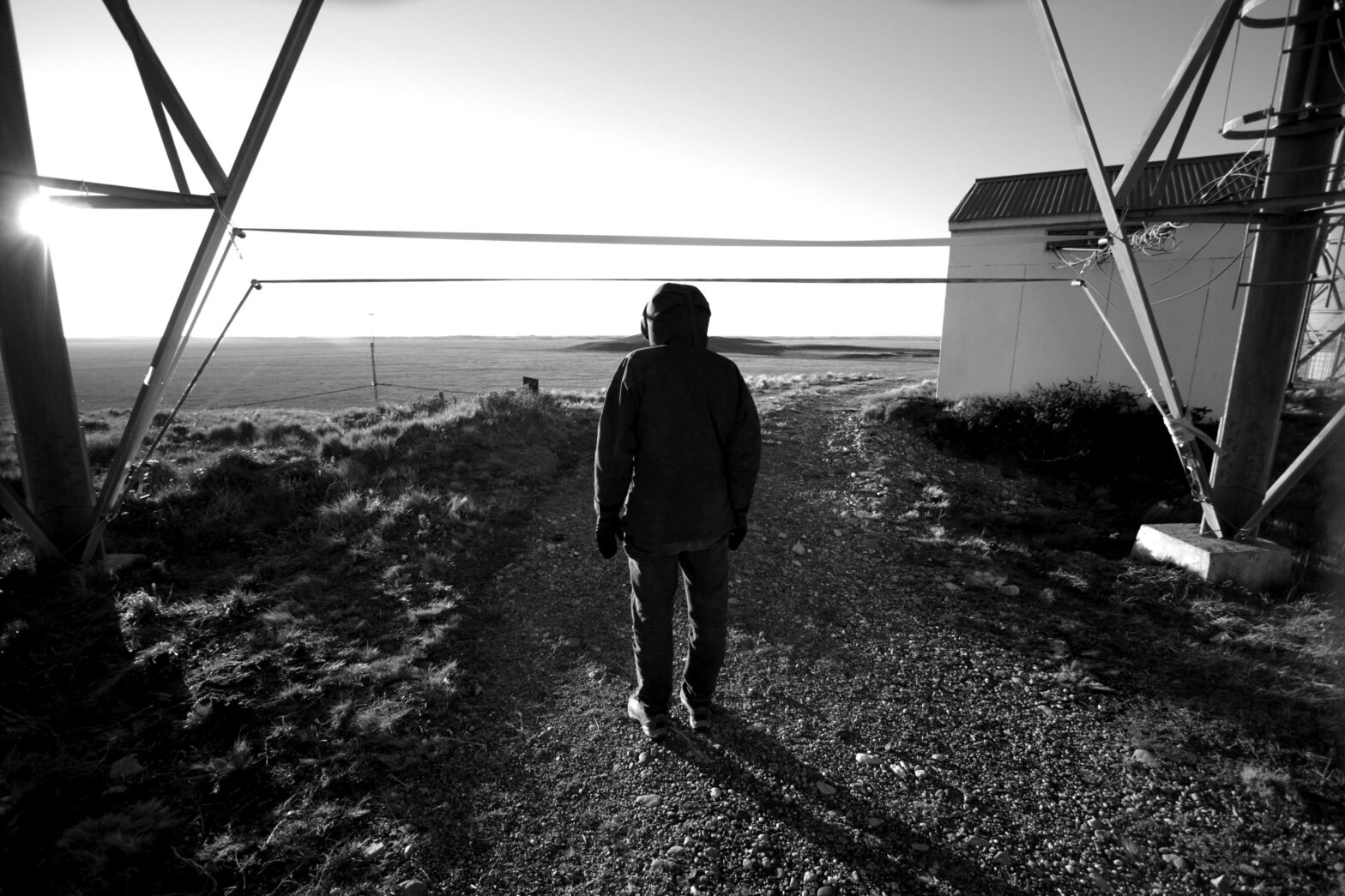
What were once solid constructions now serve as a source of material for fuel; the harbor crumbles, and its steel structures rust. What could be the future of any unviable town is now the supporting structure for the oscillator, which vibrates with its three strings, resonating through two empty fuel tanks of thousands of liters. The structure battles the wind, reclaiming this space with metallic roars.

953-1176 [Bahía Róbalo]

54°55’51.2”S 67°39’17.6”O / 953-1176 cm

Between two anti-aircraft batteries, these ropes vibrate. The wind that once battered the shores of the Yagán village now reverberates through the war material built to defend the coast against an imminent enemy on the other side of the Beagle Channel / Onashaga. The wind that eroded the coasts and their ancient archaeological remnants is the same force now wearing down the military material, pointing toward a channel that, rather than uniting, seems to separate.

Osciladores

MAC / UMAG 

Oscilador is a tool that resonates architectural structures using technological devices. 

Inspired by wind oscillators installed at 7 points in the Magallanes and Chilean Antarctic Region, this device emulates the resonance achieved by wind forces through sinuous waves generated by custom-built electromechanical oscillations. Controlled digitally, two industrial motors transmit their vibrations to the architecture of the location. Whether in a postcard image or now in the courtyard of the University of Magallanes’ Faculty of Engineering, this work engages with the building’s architecture and the power of industry.

Environmental Linguistics

purīyaū
To come with noise as wind through a hole, as a sound from a trumpet.
To make any buzzing noise as an instrument with a faulty tongue.
To breathe making a noise as when one has a cold, to pass air through the nose with noise.

(from Yamana English Dictionary – a Dictionary of the Speech of Tierra del Fuego, by Reverend Thomas Bridges, 1865)

Voice and terrain

Early travellers encountering Tierra del Fuego and its inhabitants had comments about the particular sound of their language(s). Written accounts, dictionaries and recordings reveal fascinating insights in to cultures that are deeply entangled with their natural habitat.

This project grew out of a commitment to those entanglements and attempts to trace exchanges between cultural features and material properties of the location. In particular language-landscape links that go beyond mere vocabulary encapsulations of topography, seeking instead elemental imprints of terrain and climate on the sonority of spoken words. 

Continue reading “Environmental Linguistics”

Batimientos – Schwebungen

By Kerstin Ergenzinger & Florencia Curci

Preparing the walk through the Lapataia valley with maps and through the cartographic gaze from afar we strongly felt our foreignness and the valley’s negative space. Its resonance space was an external void. Its prevailing elements seemed to be water and wind.

We imagined bodies and voices in the winds. We imagined to join with our breath sounding tones without semantics.

Continue reading “Batimientos – Schwebungen”

Lärm

by Florencia Curci, Fernanda Olivares & Nicolás Spencer

The noise emanating from the sea serves as a wake-up call, a mechanism or device, an artifice that heralds an emergency with nymphs’ cries from a place, be it a utopian or dystopian topos. This is how a narrative emerges, originating from the depths of the sea, carried by air currents and surface waves, creating turbulence as it interacts with the seabed and crashes against the coastal breakers. The mythological noise, or “Lärm,” undergoes a transformation and dissolves, taking on premonitory forms or dystopographies.

Continue reading “Lärm”

Piped Overtones

Gaseous vibrations in pipes display distinctive overtone patterns, linking the lengths of pipes with the propagation speeds of the gasses through which energies travel. Accelerating reconfigurations in piped energies across national borders along Germany’s northern coastline, sustain overtones of global geopolitics, reverberating throughout the local milieu.

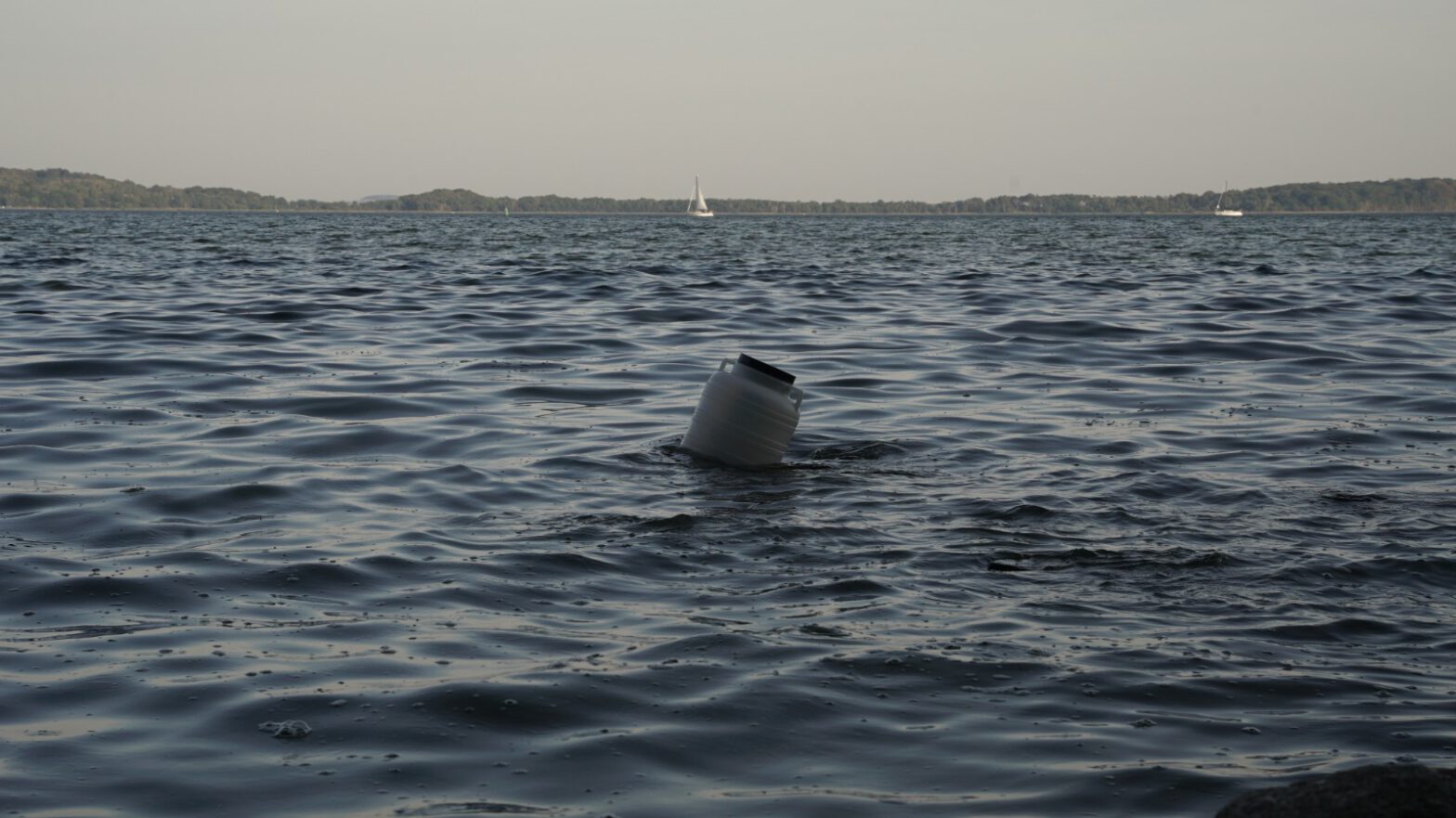
Recordings conducted at various locations on Rügen, monitored from inside a common rain gutter pipe tuned to a 76.8 Hz resonant overtone, amplifies in-situ residual hums emanating from the Neptune regasification vessel moored at the industrial port of Lubmin, gateway to the Nord Stream 1 & 2 pipelines.

Continue reading “Piped Overtones”

Cultural marks & treeprints

As Robert Carracedo points in his archeological report of TIF 23, evidence of culturally modified trees has been found in the Bahía Blanca area by the Terra Ignota team. This bay, and specifically the forest near the Bahía Blanca 2, 3 and 4 shell middens, presents an optimal location for bark extraction. The main problem at this location is that the forest has been exploited for decades for timber extraction. Therefore, without dendrochronological dating we cannot be certain of their age and, consequently, we cannot relate them to the indigenous occupation of the site.

Continue reading “Cultural marks & treeprints”

Kites: Soaring Through myths, history, science, and art research

In the vast tapestry of human history, certain inventions and innovations stand out as marvels of ingenuity, merging science, art, and culture into a single canvas of human achievement. The humble kite, with its roots reaching back thousands of years, is one such marvel. Often associated with carefree leisure on sunny days, kites have also been instrumental in science, war, climate research, and artistic expression. This essay embarks on a journey through time and disciplines, exploring the multifaceted role of kites in shaping our world.

Continue reading “Kites: Soaring Through myths, history, science, and art research”

Holobionte – Harnesing the wispers of wind: windmills, windengines and energy harvesting tools

By Florencia Curci, Victor Mazón Gardoqui & Nicolás Spencer

The utilization of wind energy represents an ancient relationship between humanity and the natural world. Windmills, wind engines and wind generators embody this enduring connection and stand as both scientific marvels and artistic expressions. We will delve into the historical chronology of these remarkable devices to celebrate their scientific and artistic significance.

Continue reading “Holobionte – Harnesing the wispers of wind: windmills, windengines and energy harvesting tools”

A Mysterious Hum – comparable snippets

Here you can listen to 30 secs edits of field recordings from different locations on the island of Rügen. Starting on the mainland at Lubmin industrial port with an ‘as close as we could get’ perspective of the FSRU (Floating Storage Regasification Unit) currently stationed there. These recordings have captured the ubiquitous low drone that eminates from the regasification vessel Neptune (also known as FSRU) to various locales, up to 61,5km away, on Rügen. (a list of the order of recordings is below)

Continue reading “A Mysterious Hum – comparable snippets”