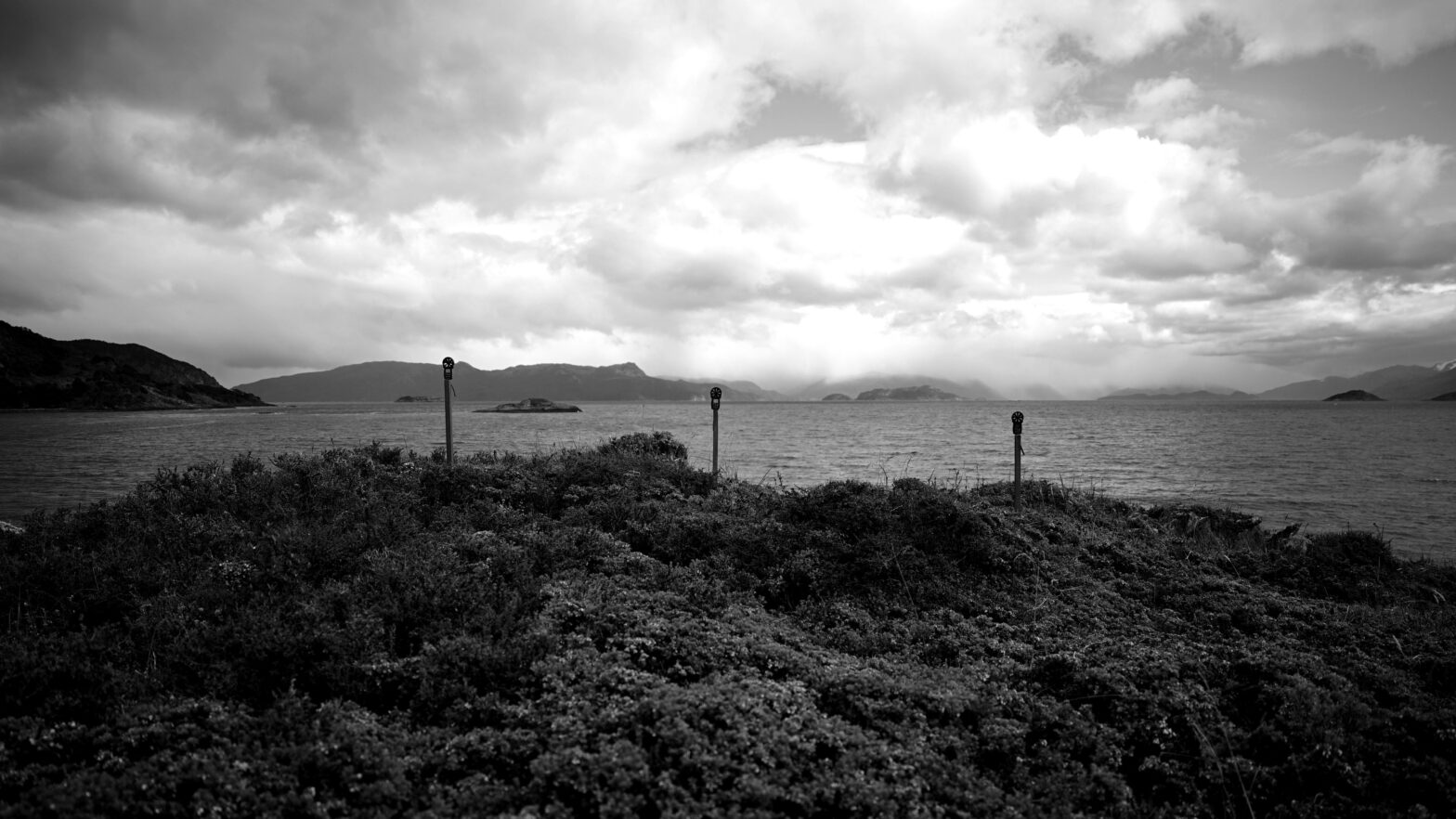
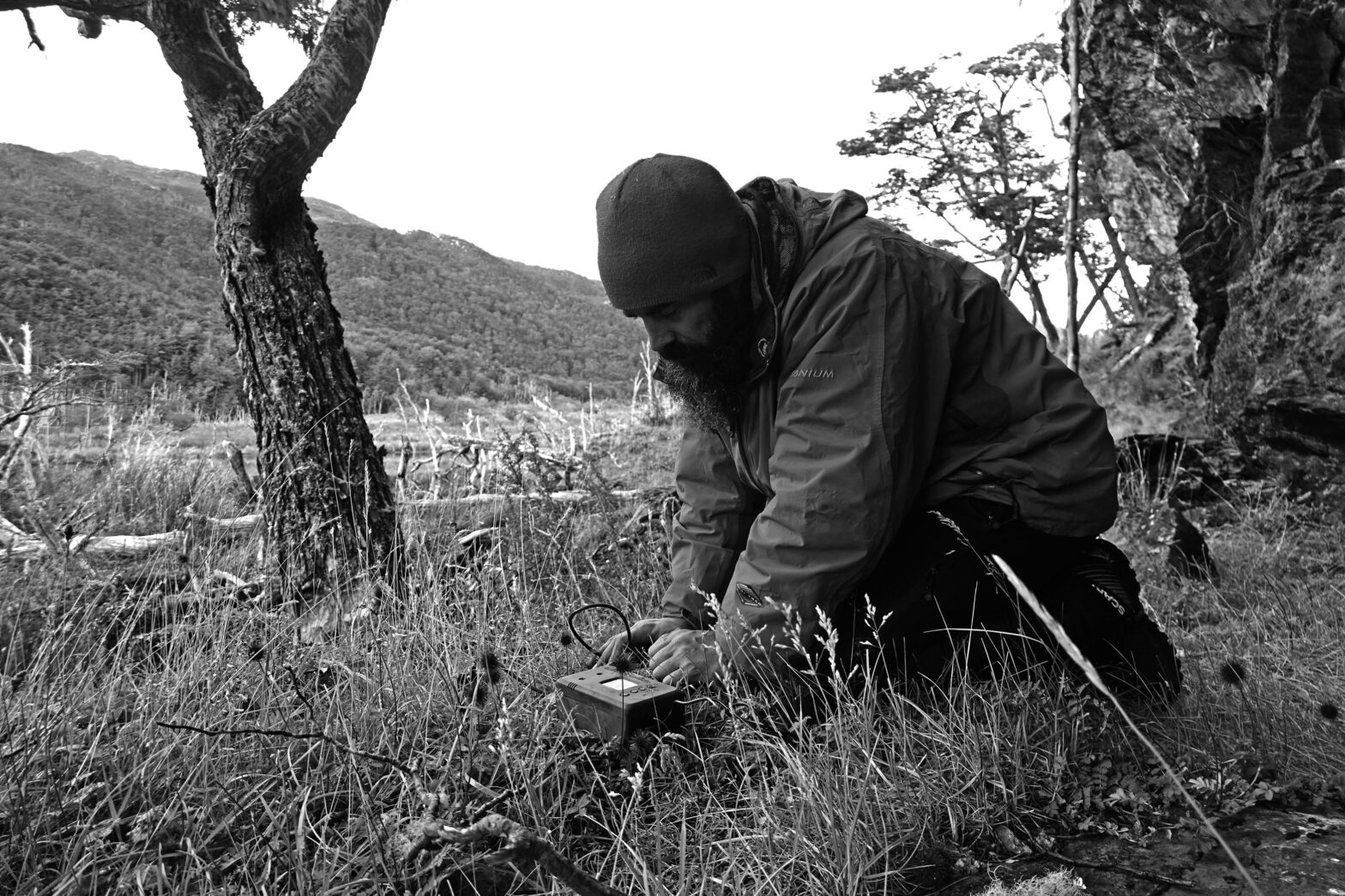
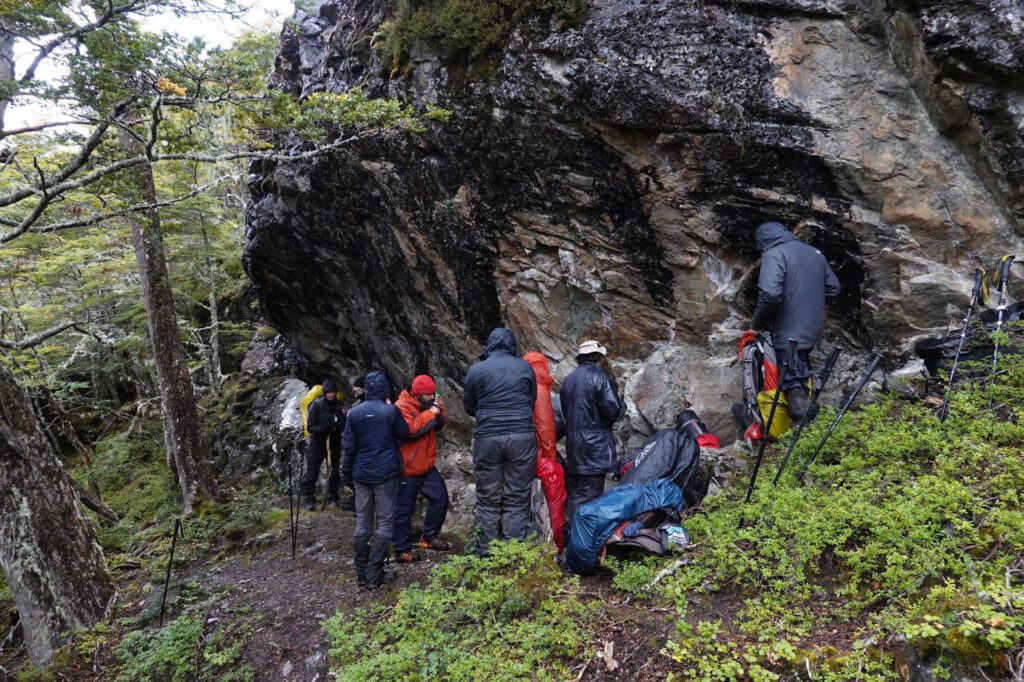
Radiales understands Bahía Wulaia and Seno Ponsonby as a living archive, where landscape, wind, water, and rock record signals of cultural and natural information. The project interprets heritage as a dynamic process of transmission: the place becomes both receiver and transmitter of experiences, knowledge, and memories, able to connect with the community and transcend the physical and temporal limits of the territory.
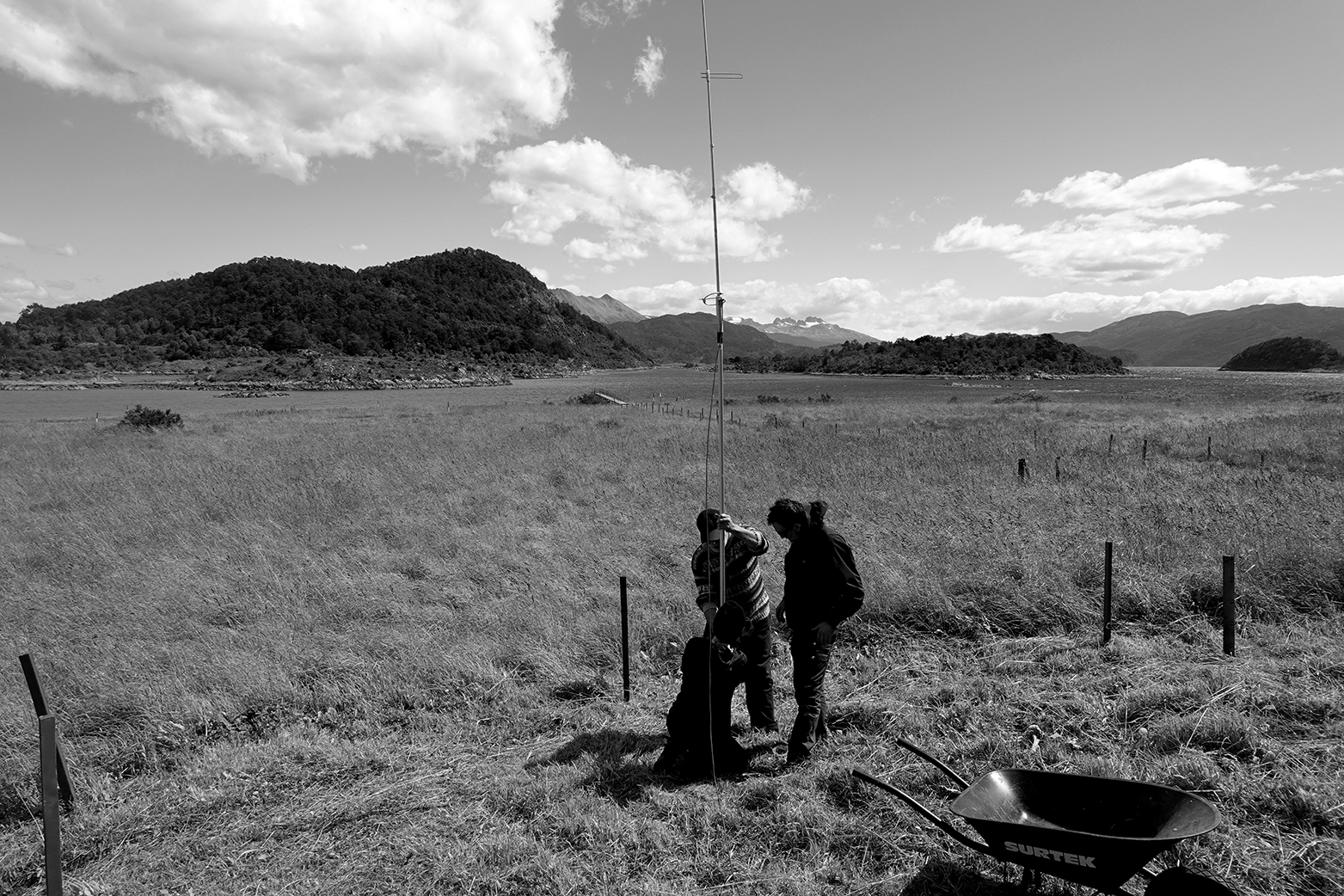
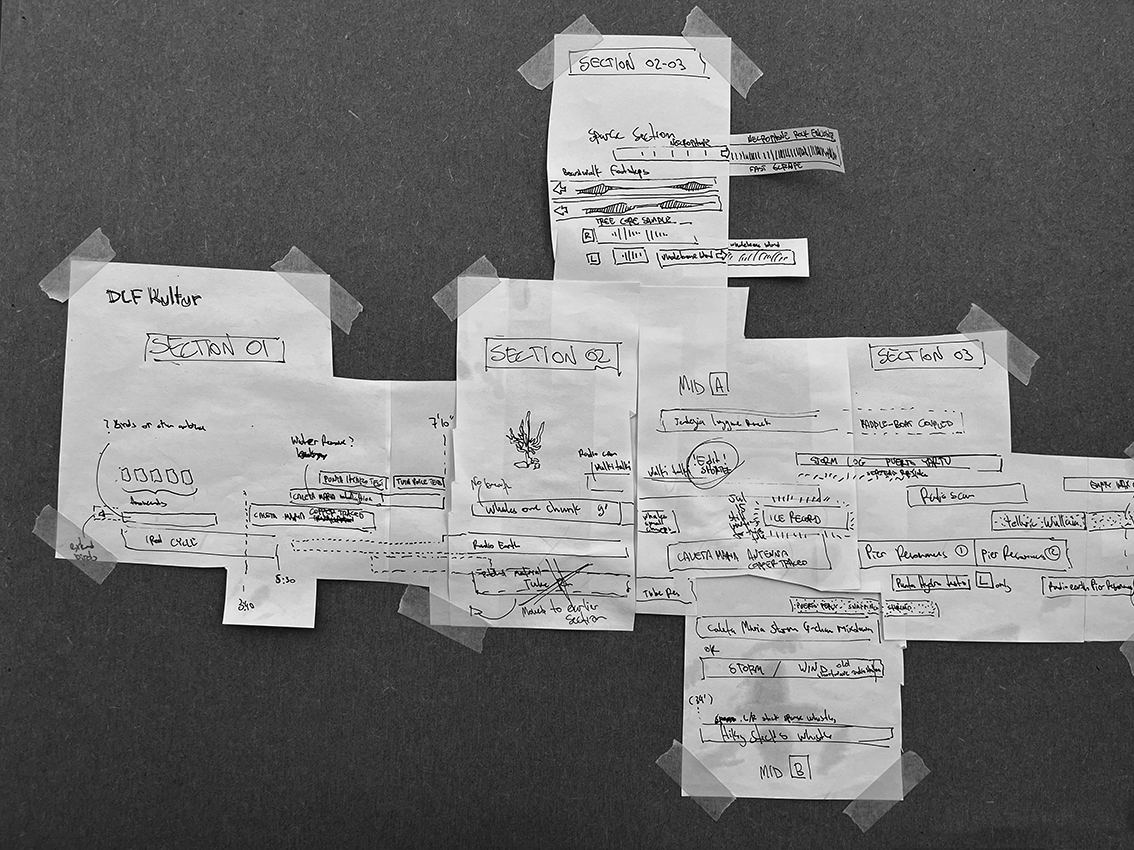
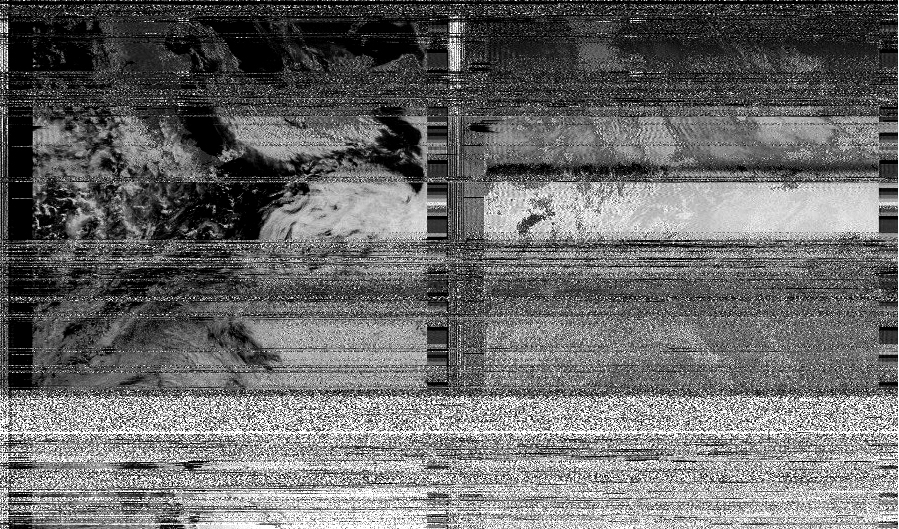
During this year’s exploration, we will install a radio studio in the former Wulaia station and broadcast daily. We will continue the research in situ, offering listeners a perspective on different projects while experimenting with the radio format itself. Live transmission is proposed as a methodology: a way to release the research at the very moment it unfolds, opening the possibility for the process to be affected by the resonances and encounters that may arise in the territories it reaches.
BIG REANIMATION CEREMONY:Thu. Feb 5th from 15 to 19H CL / 19 – 23H EU (GMT +1)
Soon the archived version of the show will be online here!
Radio partners: Radio Tsonami [CL], Monteaudio [UY], Bauhaus FM, readio.earth [DE], Radiolibre [CO], Radius [US]
This audio montage consists of raw location recordings, with no added audio effects, tracing a research journey through Chile’s southernmost regions (Tierra del Fuego and Navarino Island) to the decommissioned radio station at Wulaia Bay.
Since 1967, Villa Ukika —founded as part of state relocation policies— has been the main Yagán settlement on Navarino Island, in the heart of the Fuegian archipelago. In its surroundings, the Ukika Municipal Park stands out as a true living archive of ancestral knowledge and history, thanks to the presence of at least 103 documented Culturally Modified Trees (CMTs) to date.
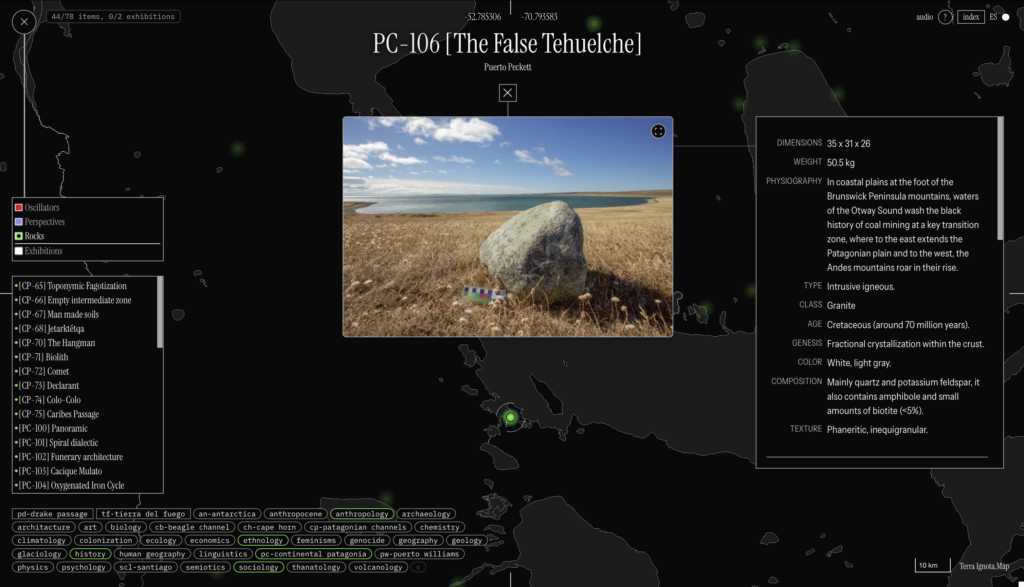
This application is designed to distribute the content stored in rocks, wind, and the gaze of a subjective observer along 1000 km of the fire-patagonian territory. The platform functions as a map that transcends the three Cartesian planes that delimit it, managing information that integrates spatial, temporal, and sensory dimensions. This is an improved version of the application created for the Terra Ignota exhibition at the Museum of Contemporary Art in 2022.
During my stay in Wulaia, I repeatedly imagine the scene of the first radio transmission. I playfully extrapolate that late 19th-century moment in the United Kingdom, where a sound generated in Bristol (England) resonated in Pernath (Wales): for the first time, I can hear something happening simultaneously but outside my immediate surroundings. It is not just an acoustic phenomenon; in some way, time and space are transformed. Something happening elsewhere, in real time, reaches my ears, challenging the physical boundaries that once defined my daily experience.
This research aims to get in tune with the intensities, turbulence and heterogeneity of the the masses of moving air based in Wulaia/Ponsonby. I would like to generate experiences that allow us, in a sensitive way and with rudimentary technologies, to tune in to (1) the complexity of chaotic movements that make up the winds (2) and how this invisible activity shapes not only the physiognomy of the landscape but also the biological activity that inhabits its surface.
Whale Refractions is a research project currently underway at the Centre for Advanced Study inherit based at the Humboldt-Universität zu Berlin. Questions of addressing ‘heritage at large’ grew out of previous itterations of the Terra Ignota platform while observing oscillatory interrelations between humans and marine mammals and evolutions of cetacean underwater hearing in the historical and geological and climate contexts of the Magallanes Region.
The Murray Channel, formerly known as Yagashaga or Yagán Channel, is a silent witness to a vast cultural heritage that stretches from the ancestral past to the recent historical past. Its legacy spans from the original people who gave the bay its name, dating back over 6,000 years, to the colony and the European exploration and exploitation processes of the 19th century.
In this area, especially in Wulaia Bay, evidence of the first bark canoes, debarking sites, and sawmills for making canoes, huts, and ritual objects can be found. These vestiges allow us to identify the demographic distribution of its inhabitants and analyze changes in technologies and methods over each period.
Additionally, there is a record of countless shell middens scattered along the coast, which serve as archaeological information repositories on how the Yagán people inhabited this territory. Each mound functions as a cultural footprint, revealing the gathering techniques and practical use of marine resources by the Yagán people.
Moreover, this territory witnessed recent historical activity, and remnants of expeditions from religious missions such as Gardiner (1850), Bridges (1871), Gusinde (1918–24), and Agostini (1927) could be found, as well as scientific [FitzRoy, Darwin, HMS Beagle (1830–1836), Romanche (1882)] and Antarctic expeditions [Drake (1578–1580), Cook (1772–1775)]. (See Bibliography below).
Yagán Community of Navarino Island
The Yagán Indigenous Community of Bahía Mejillones, is a group/association that has been operating for over 20 years. Its primary driving force has been to maintain perpetual contact with the common physical space, which is Bahía Mejillones, located 25 kilometers from Puerto Williams. It is entirely composed of descendants of the Yagán people, who share their knowledge with each other and then pass it on to younger generations with the hope of perpetuating their knowledge.
A key aspect of the Yagán Indigenous Community of Bahía Mejillones is its challenge to keep the language alive and its ability to preserve ancestral traditions related to the craft of weaving with plant fibers (Gleisner and Montt 2014). Despite adapting to the current context, techniques in plant fibers and traditional forms are preserved, representing invaluable intangible heritage.
These activities play a crucial role in building their cultural identity. The fishing, hunting, and object-making techniques passed down from parents to children reflect a deep respect for and understanding of ecosystems, as well as wisdom about how to interact with them sustainably. In this sense, the Yagán community not only maintains traditional practices but also plays a fundamental role in preserving the region’s natural resources.
Diagnosis of the Cultural Heritage Postulated in the Project
Bahía Wulaia Bahía Wulaia lacks legal protection despite its designation as a Heritage Route. Currently, it is under partial management by COMAPA, a cruise company that converted the old radio station into a museum. The lack of a management plan worsens the problem, considering its environmental and historical-heritage value. Bahía Wulaia is home to Yaghan remnants, such as cemeteries and tools, and was the scene of historical encounters, such as Darwin’s visit in 1833 and the return of Jeremy Button (Fitz-Roy, 1839; Martinic 2005) (See Attached Bibliography for references cited in the project).
Shell Middens Numerous shell middens have been identified in the area, with an estimated one hundred and twelve between Seno Grandi and Bahía Wulaia. Surveys conducted between 1991 and 1993 by C. Ocampo and P. Rivas (2000) supports this estimate. A greater quantity is suggested to be unexplored, deduced from historical-demographic data by Dominique Legoupil, who notes a high population in the area in the past (Legoupil 1993; Legoupil and Lira 2017). The conservation status of these shell middens and cultural traces has not been assessed, but there may be degradation due to human activities because of the lack of protection. There is no complete cadastral survey or cartography of previous expeditions.
Bark Stripping No data is available on the cultural marks resulting from the stripping of trees for the manufacture of canoes and other objects. There is no systematized database of these marks that could continue ethnographic studies. Furthermore, there is no cartography of these cultural traces to allow for their protection and conservation, or to prevent their destruction due to logging.
Situation of the Yaghan People The Yaghan people were recognized as an indigenous people by the State of Chile through Law 19.253 of 1993. However, currently, the areas that were historically their main habitat (from the southern coast of Isla Grande de Tierra del Fuego to the Cape Horn Archipelago) are difficult or impossible to access. The Yaghan were displaced from their occupied areas within a few years, first by the arrival of Europeans and later by the Chilean State. Sites such as Wulaia, Douglas, Tekenika, and Bahía Mejillones had to be abandoned by the Yaghan, as they were relocated in 1967 to Villa Ukika, on the outskirts of Puerto Williams. As of the 2017 Census, 1600 people identified as Yaghan. The Yaghan Community still engages in various activities related to their ancestral practices. However, their navigation has been restricted, subject to a series of regulations that prevent free travel through the channels.
The Yaghan Language The Yaghan language is increasingly less used by this indigenous people in the southernmost part of Chile and Argentina. It is a language isolate, with only a few elderly speakers remaining, as it was not continuously passed down to younger generations. Given the fragility of language preservation, indigenous toponymy is also considered at risk. Some consider Cristina Calderón (Zárraga 2017), who passed away in 2022, to be the last fluent speaker. However, there are currently dissemination and support programs to maintain the language, as well as an extensive phonographic archive in various institutes in Chile, Argentina, and Europe.
Historiographical Compilation There is an extensive bibliography addressing Yaghan territory; however, there are accessibility issues, as much of it is found in dispersed repositories and other languages. Much of this bibliography has not been written with a general audience in mind. There is also a temporal language bias concerning initial accounts and chronicles. A component of the project’s action plan is to collect and systematize this information, making it accessible to both experts and the local community.
Material Traces of Recent Historical Expeditions The material traces of expeditions around the Wulaia area have scant documentation. Despite the chronicles of Cancini (1950) detailing numerous expeditions, the expected abundance of finds in available museum repositories is lacking. It is likely that objects (cultural traces) are dismembered and scattered in various archives with minimal communication between them.
Bibliography
Ocampo, C., & Rivas, P. (2000). Nuevos fechados 14C de la costa norte de la isla Navarino, costa sur del canal Beagle, Provincia Antártica Chilena, Región de Magallanes. In Anales del Instituto de la Patagonia (Vol. 28, pp. 197-214). Instituto de la Patagonia Chile. (Link1)
Ocampo, C., & Rivas, P. (2004). Poblamiento temprano de los extremos geográficos de los canales patagónicos: Chiloé e isla Navarino 1. Chungará (Arica), 36, 317-331. (Link2)
Legoupil, D. (1993). El archipiélago del Cabo de Hornos y la costa sur de la isla Navarino: poblamiento y modelos económicos. Anales del Instituto de la Patagonia, Serie Cs., 101-121. (Link3)
Prieto, A. Permanecer o Regresar: Las comunidades ancestrales de Magallanes a partir de la Isla Hornos (Link4)
Agostini, A. (1945). Andes Patagonicos, Viajes de exploración a la cordillera patagónica austral. Buenos Aires: Taller Gráfico de G. Kraft.
Agostini, A. (1955). Treinta años en Tierra del Fuego. Buenos Aires.
Aguilera Águila, N., García Piquer, A., Piqué Huerta, R., & Prieto Iglesias, A. (2020). Fragmentos de realidad: Arqueología y etnografía de las canoas de corteza en el área del Cabo de Hornos. Anales del Museo de América, 488221, 6-34.
Anderson, C. B. (2014) Lecciones sobre la creación e implementación de la Reserva de la Biosfera Cabo de Hornos como plataforma de investigación de largo plazo. En: A Moreira-Muñoz & A Borsdorf (eds) Reservas de la Biosfera de Chile: Laboratorios para la Sustentabilidad. Academia de Ciencias Austriaca, Pontificia Universidad Católica de Chile, Instituto de Geografía, Santiago, serie Geolibros 17: 252–267
Anderson, C. B., Giesen U, Berghoefer A, Rozzi R (2003). La Declaración de Cabo de Hornos: una estrategia para la conservación biocultural en la Provincia Antártica Chilena. Revista Ambiente y Desarrollo 19: 68–69.
Bridges, L. (1952). El último confín de la Tierra. En Colección Patagonia. Buenos Aires: Emecé Editores S.A.
Bridges, T. (1893). La Tierra del Fuego y sus habitantes. Boletín Instituto Geográfico Argentino, 15, 221-241.
Bridges, T. (1987). Yamana-English: a dictionary of the speech of Tierra del Fuego (F. Hestermann & M. Gusinde (eds.)). Buenos Aires: Ediciones Shanamaiim.
Canclini, A. (1951). Hasta lo último de la tierra. Allen Gardiner y las misiones en Patagonia. Buenos Aires: La Aurora.
Chapman, A. (2012). Yaganes del Cabo de Hornos, encuentros con los europeos antes y después de Darwin. Liberalia Ediciones.
Comunidad Indígena Yaghan, de Bahía Mejillones (2021). Protocolo de buenas prácticas para la protección del patrimonio cultural indígena yagán. Puerto Williams: Ministerio de las Culturas, las Artes y el Patrimonio.
D’urville, M. D. (1842). Voyage au Pole-Sud et dans l’Oceanie sur les corvettes l’Astrolabe et la Zelee 1837-1840. Historie du voyage. Paris: Rue des Petits-Augustins 5.
Darwin, C. (1988). Charles Darwin’s Beagle diary (R. D. Keynes (ed.)). Cambridge: Cambridge University Press.
Darwin, C. (2008). The Voyage of the Beagle. United Kingdom: Dodo Press.
Díaz-Andreu, M. (2005). Género y arqueología: una nueva síntesis. En M. Sánchez Romero (Ed.), Arqueología y género (pp. 13-51). Granda: Universidad de Granada.
Fitz Roy, R. (1839). Narrative of the Surveying Voyages of His Majesty’s Ships Adventure and Beagle Between the Years 1826 and 1836: Describing Their Examination of the Southern Shores of South America, and the Beagle’s Circumnavigation of the Globe, vol.2. H. Colburn.
Gándara Vázquez, M. (2016). Difundir o divulgar, he ahí el dilema. El patrimonio cultura y las tecnologías digitales, experiencias recientes desde México, 56 (red temática), 19.
Gusinde, M. (1986). Los Indios de Tierra del Fuego. Los yámana. Primera parte: Patria e historia de los Yámana: Vol. I. Buenos Aires: Centro Argentino de Etnología Americana.
Gusinde, M. (1986). Los Indios de Tierra del Fuego. Los yámana. Segunda parte: La vida económica: Vol. I. Buenos Aires: Centro Argentino de Etnología Americana.
Legoupil, D. (1993). El archipiélago del Cabo de Hornos y la costa sur de la isla Navarino: poblamiento y modelos económicos. Anales del Instituto de la Patagonia, Serie Cs., 101-121.
Legoupil, D., & Lira, N. (2017). Los canoeros del fin del mundo. En C. A. del Solar (Ed.), Cabo de Hornos (pp. 64-99). Santiago de Chile: Museo Chileno de Arte Precolombino.
Martial, L. F. (2005). Mision al Cabo de Hornos. La expedición científica francesa en la Romanche julio 1882-setiembre 1883. Ushuaia: Zagier & Urruty Publications.
Martinić, M. (2002). Breve historia de Magallanes. Punta Arenas: La Prensa Austral.
Martinić, M. (2004). Archipiélago Patagónico la última frontera. Punta Arenas: La Prensa Austral.
Martinić, M. (2005). Crónica de las tierras del sur del Canal Beagle. Punta Arenas: La Prensa Austral.
Milek, K. (2018). Transdisciplinary Archaeology and the Future of Archaeological Practice: Citizen Science, Portable Science, Ethical Science. Norwegian Archaeological Review, 51(1-2), 36-47. doi: 10.1080/00293652.2018.1552312
Neuman, T. R. (ed.) (2022). Una nueva australidad para Chile. Santiago de Chile: Universidad Autonoma de Chile.
Ocampo, C., & Rivas, P. (2000). Nuevos fechados 14C de la costa norte de la isla Navarino, costa sur del canal Beagle, Provincia Antártica Chilena, Región de Magallanes. In Anales del Instituto de la Patagonia (Vol. 28, pp. 197-214). Instituto de la Patagonia Chile.
Ocampo, C., & Rivas, P. (2004). Poblamiento temprano de los extremos geográficos de los canales patagónicos: Chiloé e isla Navarino 1. Chungará (Arica), 36, 317-331.
Outes, F. F. (1925). Sobre el idioma de los Yamana de Wulaia (Isla Navarino). Revista Museo la Plata, Tomo XXX.
Saldaña, L. M. A., Morales, E. Á., & Núñez, R. A. T. (2021). Territorio, espacio público y género. Ciudad de México: Ediciones Navarra.
Zárraga, C. (2017). Cristina Calderón. Memorias de mi abuela Yagan. (O. Vogles, Ed.). Punta Arenas: Ediciones PIX.
Zegers, G., Fernández, M., Cáceres, B., Prieto, A., Carracedo, R., & Östlund, L. (2020). Reporte del hallazgo de árboles culturalmente modificados en bosques costeros de Nothofagus Betuloides (Mirb.) Oerst 1871 (Nothofagaceae) por pueblos canoeros de la Patagonia austral y Tierra del Fuego. Antropologías del Sur, 7(13), 245-253.
Before the research trip to the Zona de Contacto Intercultural, Fernanda Olivares and Nicolás Spencer were invited to participate in a residency at Weltmuseum Wien to be part of the exhibition “Extinction!?” as part of the TAKING CARE project. The idea of this residency was to work with objects from the collections obtained by Martin Gusinde and Carl Hagenbeck and explore new museographic approaches based on perception, feelings, the discussion around extinction, and the recognition of the Selk’nam community in Chile as a living community.
We investigate the objects of the Selk’nam collection to later display the results for a year in the exhibition rooms of this former anthropological museum. We approached these objects cautiously, understanding that they have their own position and agency independent of who observes them, a place as a result of a long history, with multiple meanings and ways of being interpreted. For this, we began by understanding their ecosystem, from the periphery of the city to the elemental particles that constitute these artifacts.
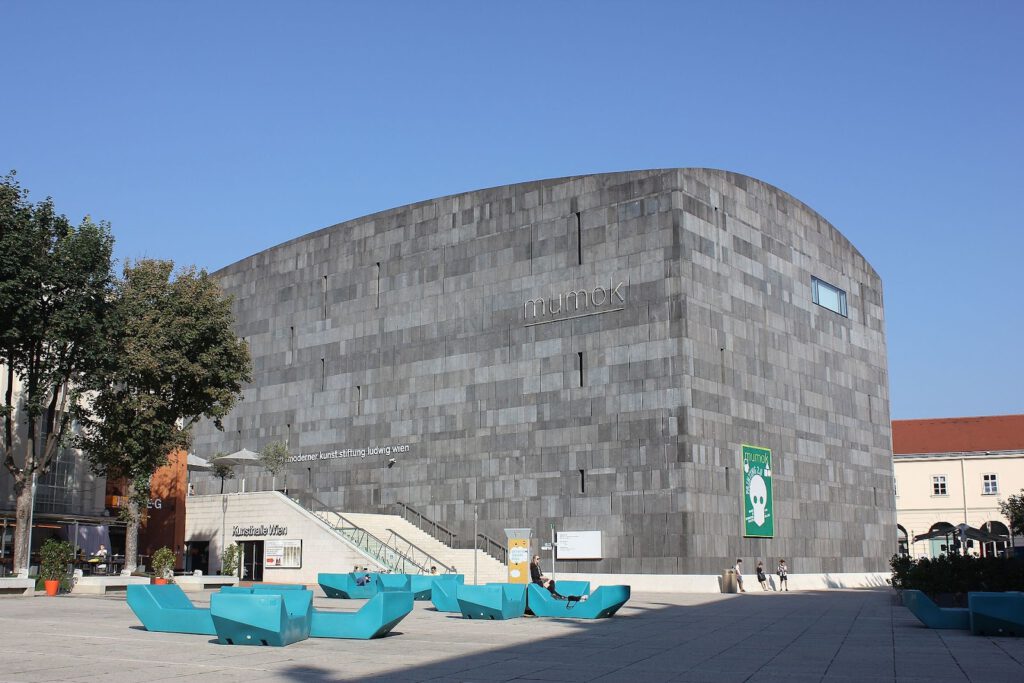
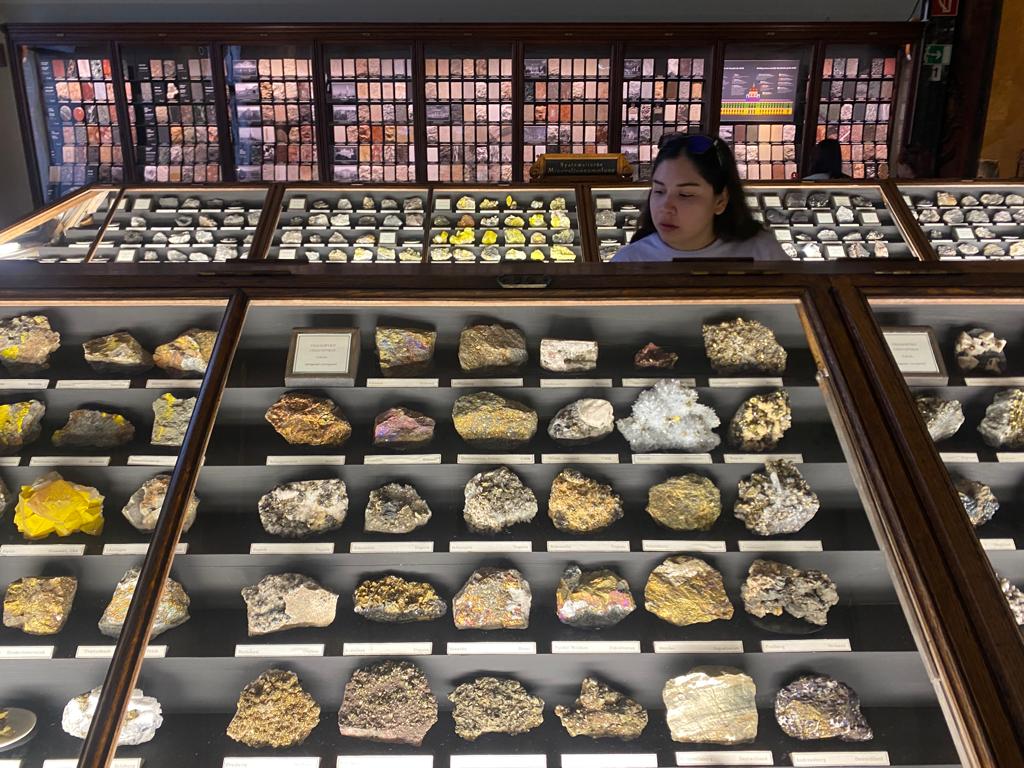
We initiated a field study that began in the city of Vienna, exploring its cultural environment through its museums and their different logics of representation. In pursuit of this goal, we interviewed people connected with various museums and institutions such as the Weltmuseum, Vienna (Claudia Augustat, Christiane Jordan), the Museum of Natural History (Constanze Schattke), the Missionshaus St. Gabriel (Fr. Franz Helm), and the Museum of Contemporary Art, Mumok (Susanne Neuburger).
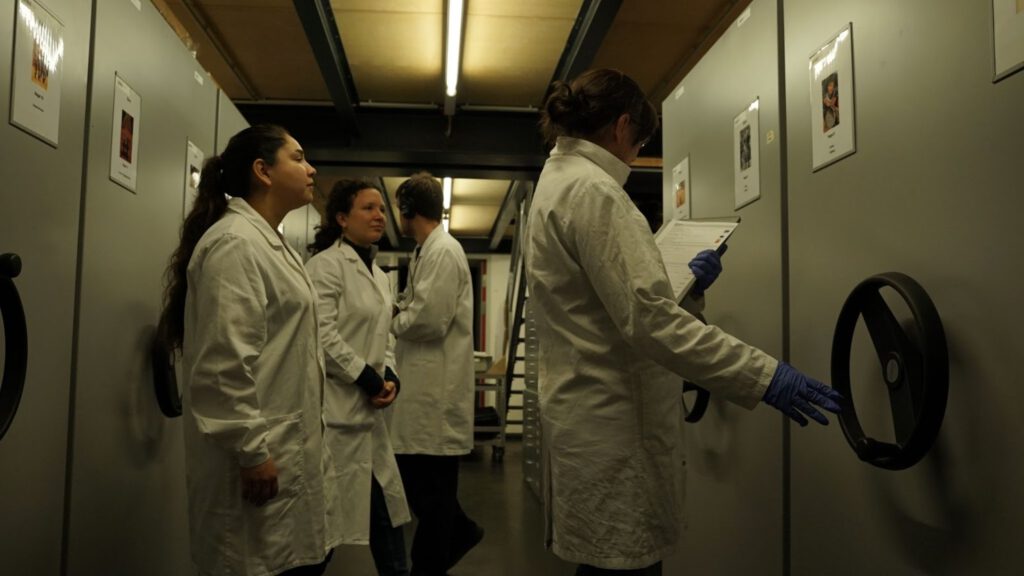
conservation storage at Weltmuseum ViennaMumok, Museum of Modern ArtMissionshaus St. Gabriel Natural History Museum Vienna
(subtitles can be activated)
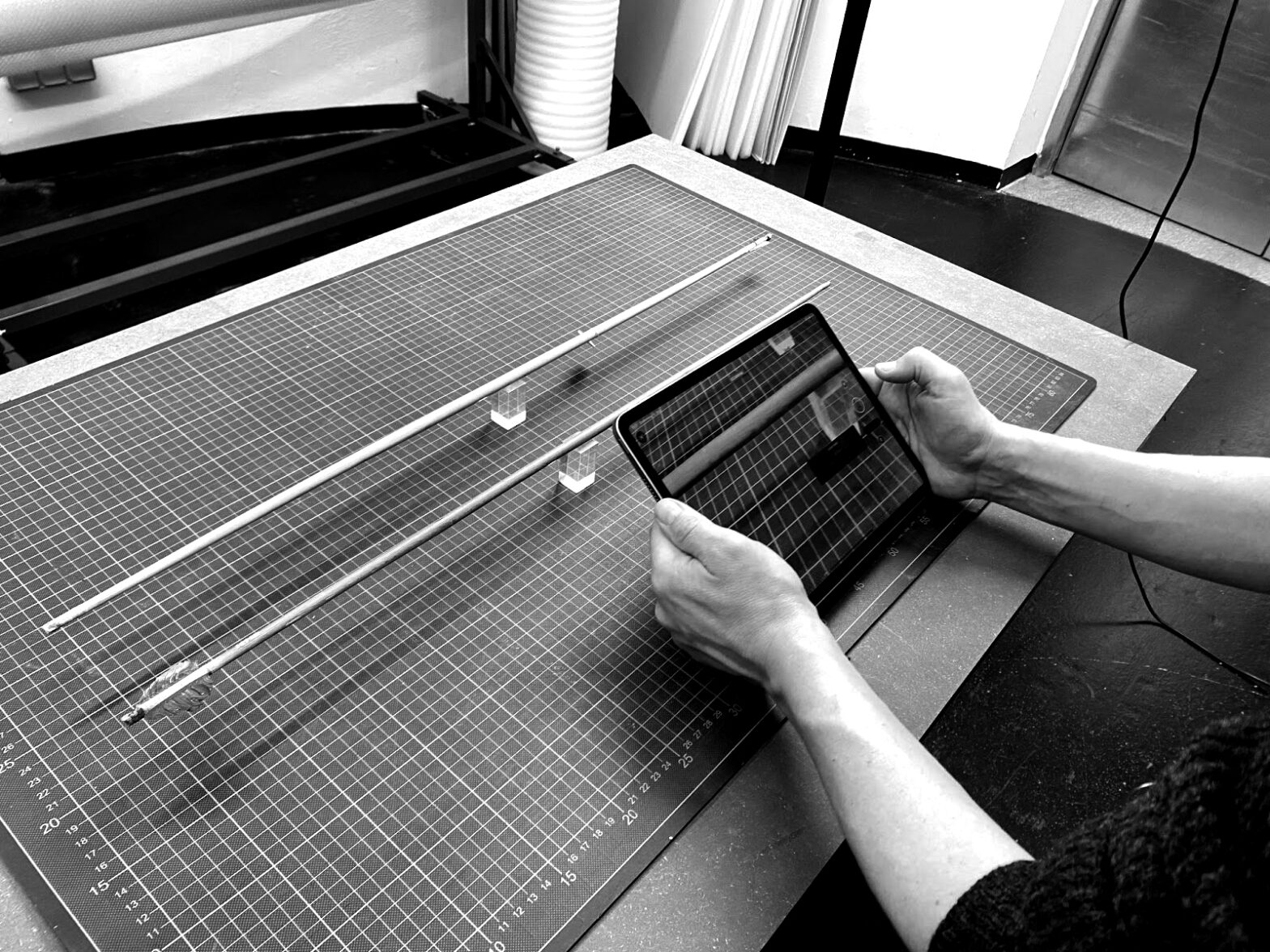
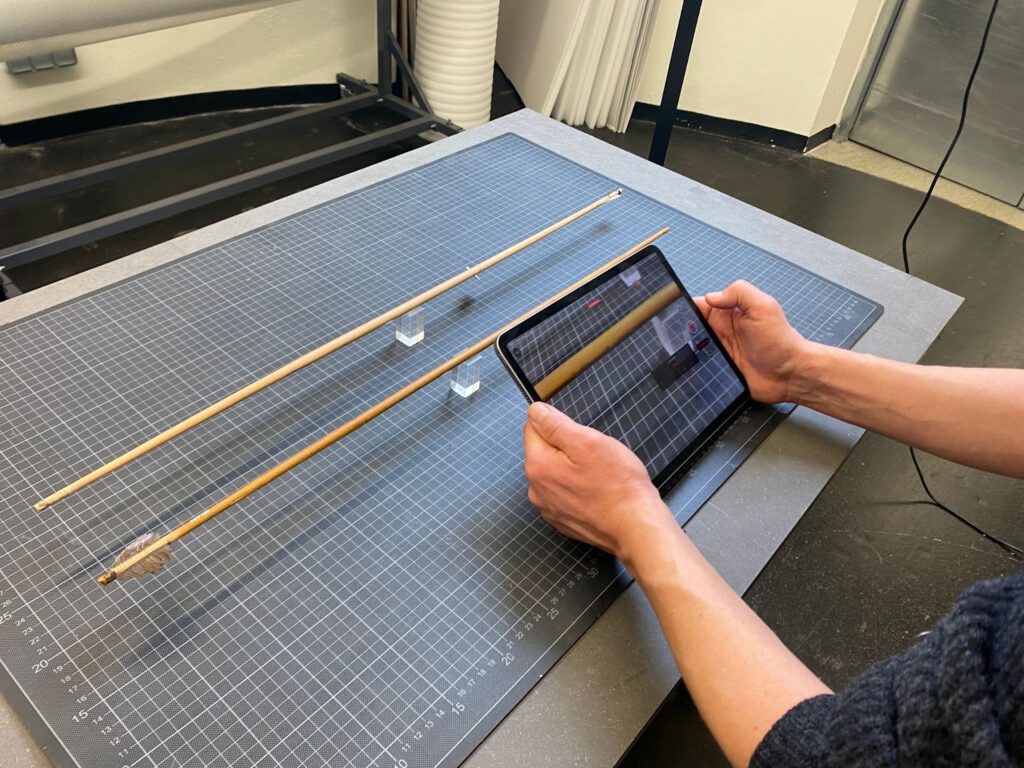
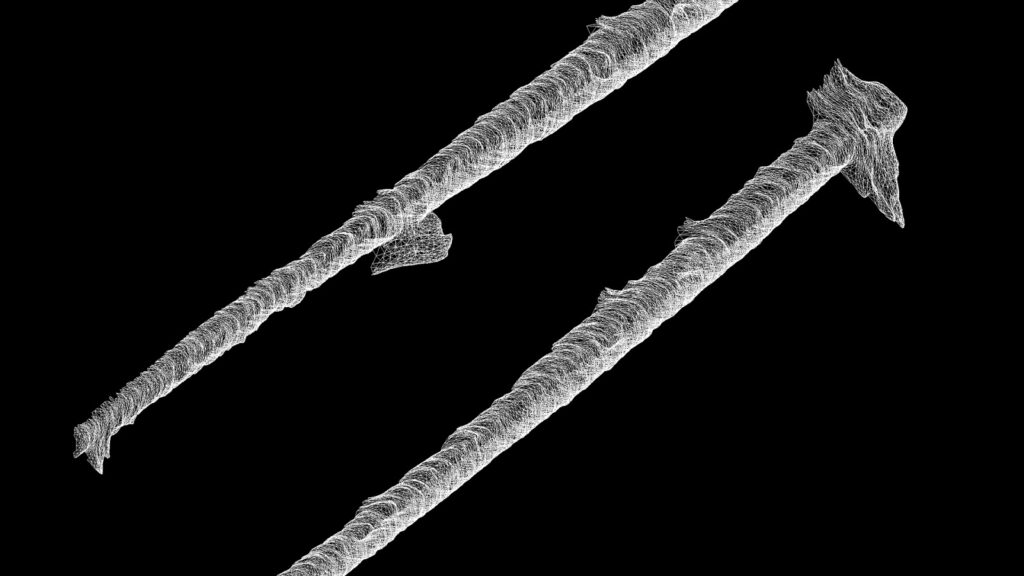
Then we delved a little deeper, cautiously observing the isolated objects in the display cases of the exhibition hall, moving through restoration laboratories to the storage and conservation warehouses. We transitioned from the controlled atmosphere that preserves them to using scanning and 3D modelling technologies to simulate the surface that is in constant contact with it.
object scanning process at Weltmuseum Vienna
Thus, from the original object, we created a vectorial and empty form, whose interior would need to be filled through creative heritage practices or what we would call “lies.”
For some, lying is an immoral act; for others, it is an act of survival.
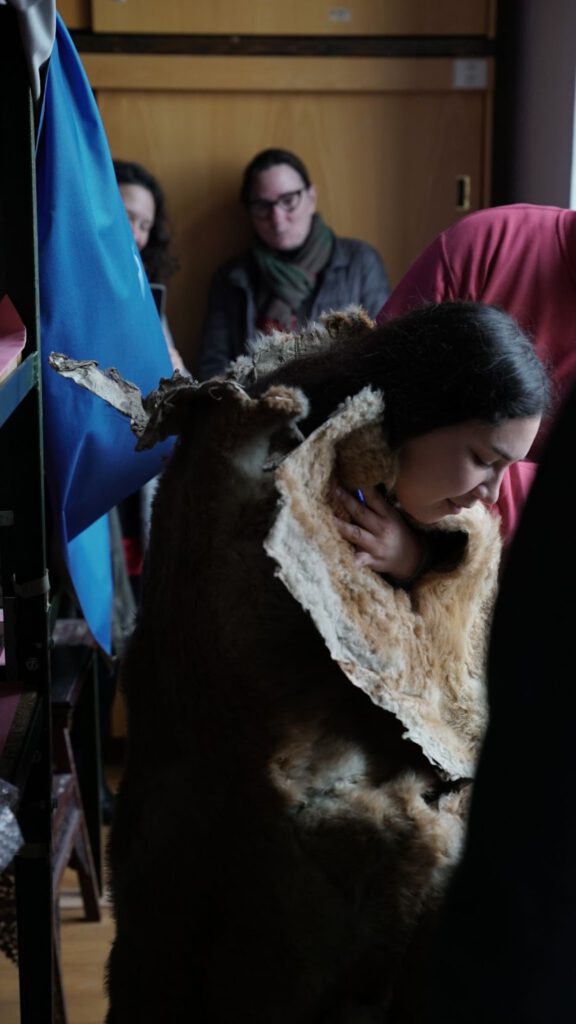
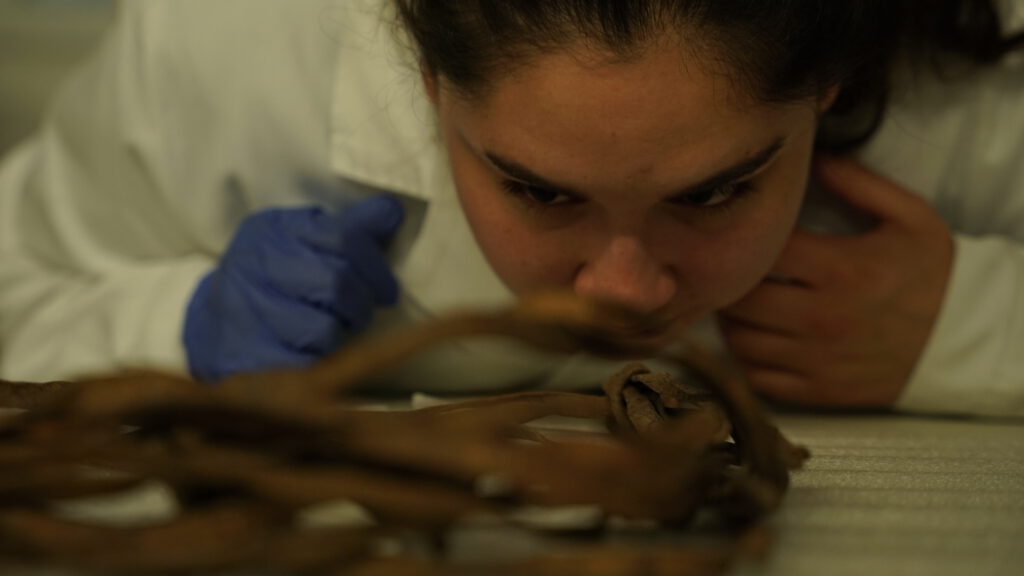
Many of the objects in the Gusinde-Hagenbeck collection were taken violently from their users. This, combined with the systematic attempt to annihilate their owners, caused these artifacts to arrive at the museum with little or no information. The same happened with their descendants, including Fernanda Olivares, who has been in a process of reconstructing her past for years. To do this, Weltmuseum Wien allowed her to come into contact with the objects, touch them, smell them, and ask them about their past. In this way, Fernanda reconstructed part of her heritage through a story she created. A version that does not contradict but rather adds to what is catalogued by 19th-century anthropologists and interpreted by thousands of museum visitors. We are based on the idea that imagination is just another portrait of reality, that it cannot go as far as believed, and that the most delusional idea is just another colourful portrait from the palette of what can be considered reality.
Analysis and handling of objects found in storage and conservation cellars at Weltmuseum Vienna
Video
The video is an essay, as mentioned, about museum ecosystems and the objects originally belonging to the Selk’nam community. The objects were scanned and emptied of their content, making them transparent so that later, through a creative process, Fernanda Olivares could re-signify them through a story, a narrative about their utility or meaning. Additionally, we integrated the sounds that coexist with these objects in the rooms that house them, along with their visitors and the people who care for and exhibit them.
After our trip to the Intercultural Contact Zone, we added footage from the places we visited in the field to the video, starting at minute 15:45. These places were similarly scanned and vectorized, to be emptied and re-signified with a perspective that invites natural spaces into the museographic discussion; the “natural” ecosystems become cultural as they are inhabited by humans, giving rise to future archaeologies.
Repatriation practices
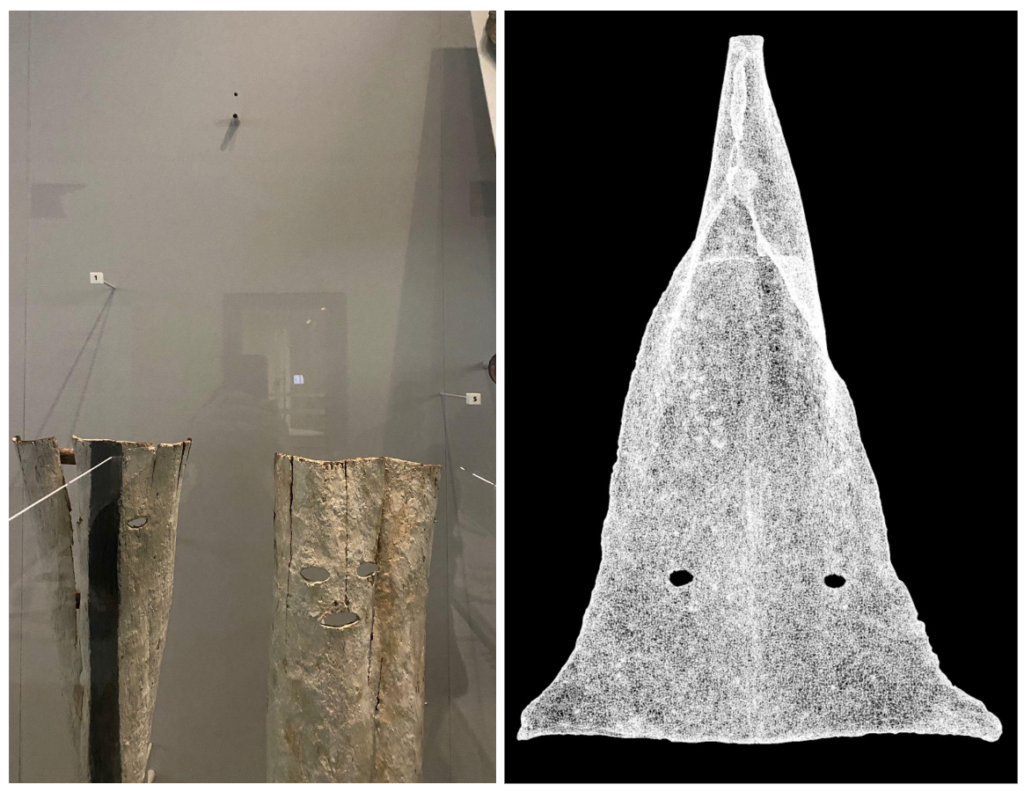
The ceremonial mask featured in the video (at 5:00 minutes) was removed from the exhibition at the request of Fernanda Olivares. After being scanned, it was printed in two copies: one remained in the ‘Extinction!?’ exhibition at the Weltmuseum Vienna, and the other was taken back to Tierra del Fuego by Claudia Augustat, curator of the South American collection at that museum. Although the plastic replica’s transfer did not adhere to any repatriation protocols, it allowed us to engage in a symbolic exercise, gaining insight into the mechanisms at play and attributing value and meaning to an object with a clear origin but imprecise significance. After its return journey, the mask would be handed over to two representatives of the Selk’nam Hach Saye Selk’nam foundation: Hema’ny Molina and Fernanda Olivares.
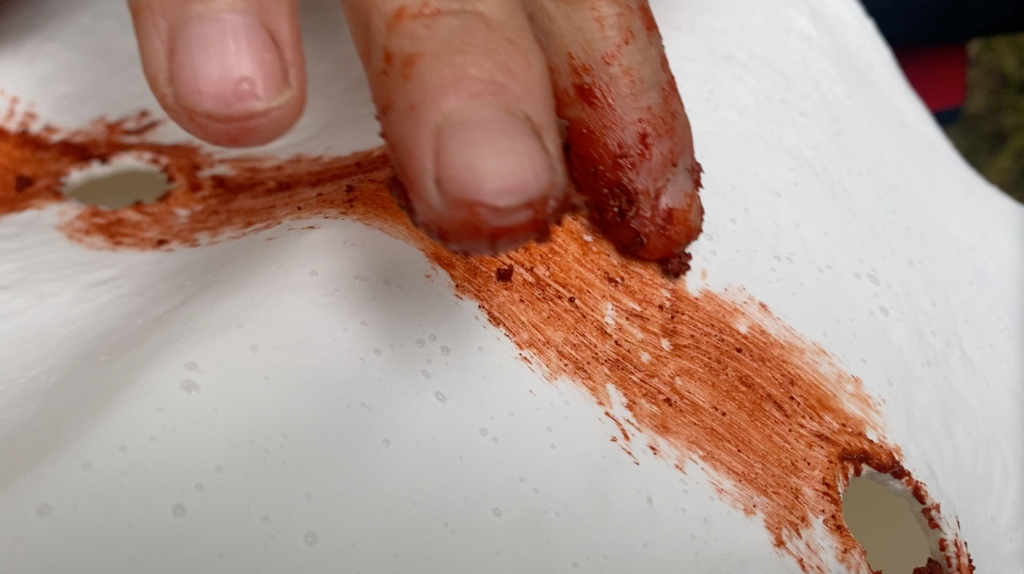
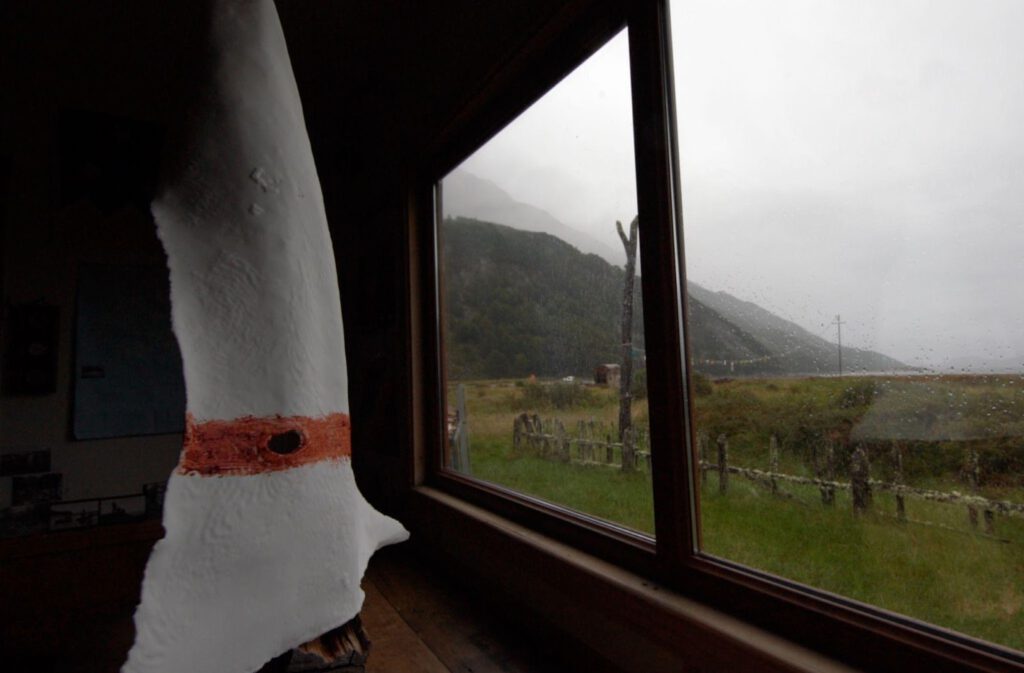
Once in Tierra del Fuego, we were invited to a ceremony at Parque Karukinka. There, the mask protection was removed, and it was symbolically presented to the forests from where it was originally taken over 100 years ago by German missionary Martín Gusinde. During this event, the plastic replica was anointed with animal fat using traditional colors that were historically used to paint bodies and cultural objects. This gesture transformed an inorganic material into a living symbol, turning an empty form into a symbolic container of repatriation.
the moment when the mask was painted in Karukinka
Detail of original mask, Weltmuseum Vienna
We were aware that the plastic mask could be seen as an extracted and exoticized object. Nevertheless, for those of us participating in the ceremony, the focus shifted away from the object itself and toward the gesture. This reversal turned a materialistic exercise into a ‘total social fact1,’ where the mask’s importance was no longer about the wearer but rather the projection of their gaze into the forest. It leads us to consider that perhaps the essence of repatriation or re-signification lies in the practice itself, and the separation of subject or object from their environment is the root of colonization, modernity, and disarray
Dislocations / Extinction!? installation
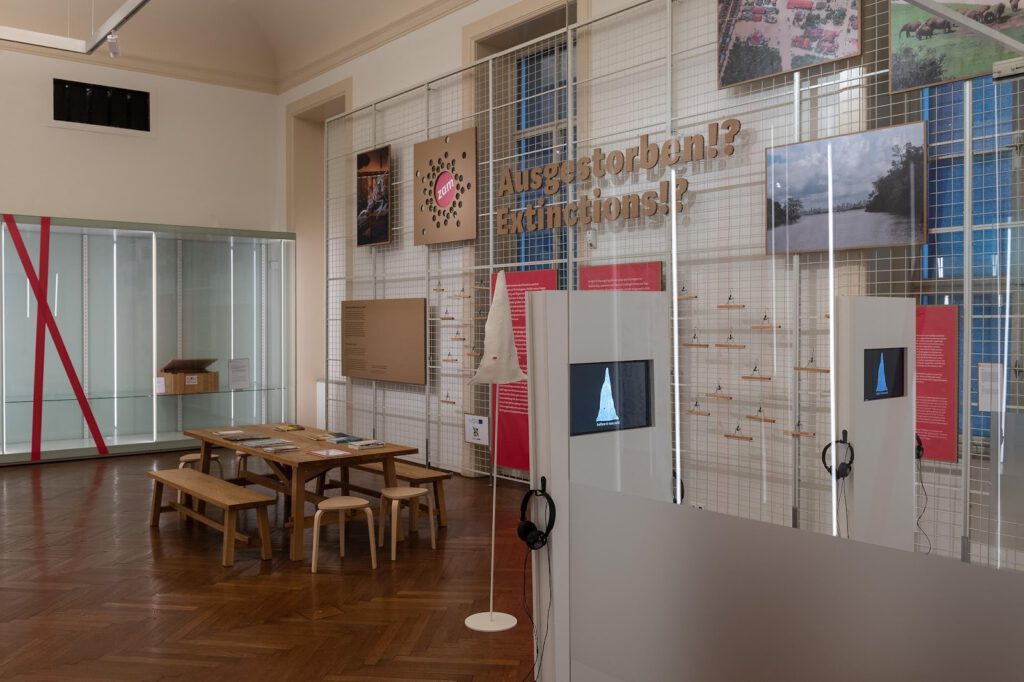
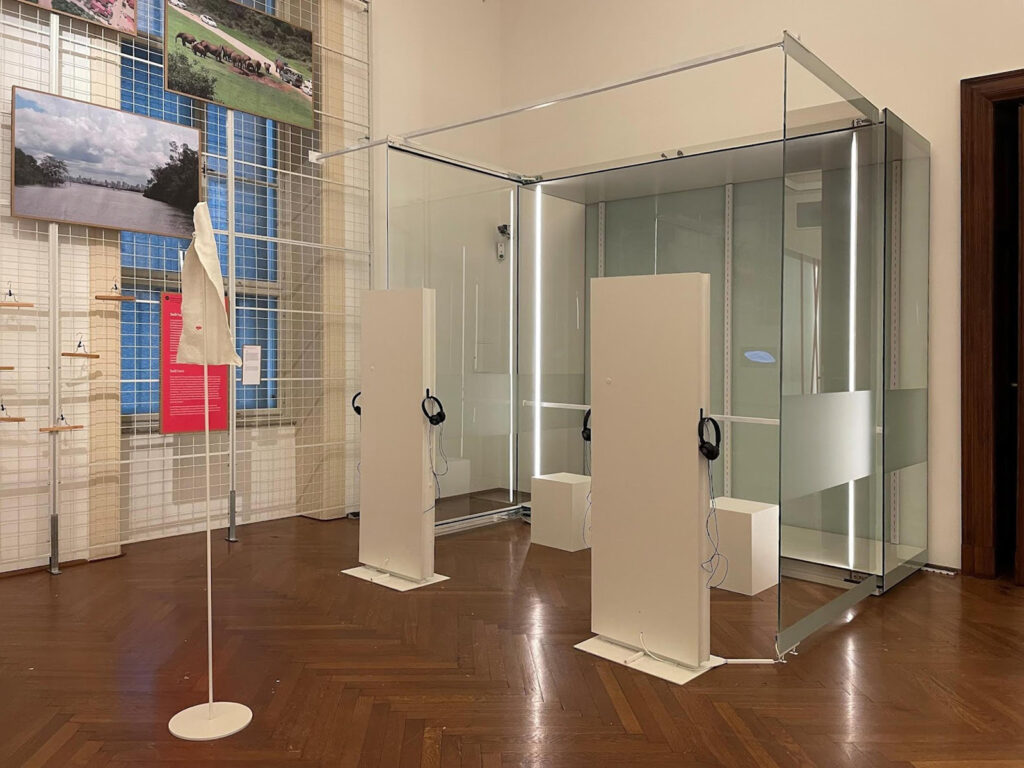
The installation was set up in “The Corridor of Astonishment” (Der Korridor des Staunens) at the Weltmuseum Wien between February 23, 2023, and April 2, 2024. The concept was to position the video in a way that creates a dislocation between the viewer and the location of the exhibited objects in the museum.
The video, which creatively explains the meaning or use of “cultural objects,” can be viewed while sitting on a plinth inside a display case. Simultaneously, a copy of the Selk’nam ritual mask, which was removed from the exhibition, observes from outside as visitors to the “Extinction!?” exhibit learn from the video. What is exhibited is the visitor’s attempt to understand a collection through imaginative exercises.
The mask leaves the display case and observes the same situation it was in for years, while the other copy is in Tierra del Fuego, observing the valleys, forests, and bays from where it was once taken. Meanwhile, the original mask returns to the storage room, where it is preserved in a climate-controlled and dark chamber.
“It was important for this piece to exchange positions between observer and observed, placing the viewer as an object of study. The museum visitor trying to understand other cultures is an anthropological phenomenon that can be exhibited and studied.” Fernanda Olivares
Display case from which the Selk’nam mask was removed, Weltmuseum Vienna, and scanned image of the mask
Installation view “Extinction!?” at Weltmuseum Vienna
the mask observing in Caleta María, Tierra del Fuego
Contact Zone; A Park? A Museum?
One of the goals of our field study in Tierra del Fuego was to identify and validate a contact zone between the Kawésqar, Yagán, and Selk’nam cultures—an area with natural and cultural qualities that could house contemporary museological collections. The idea was to come together to dialogue and try to understand the spaces that could represent parks and reserves aimed at conservation, museums as effective places of care, and potential spaces of cultural representation.
Parks, Reserves, and Sanctuaries
In Chile, the designations of National Park, National Reserve, and Nature Sanctuary supposedly offer guarantees for the comprehensive care of unique ecosystems. However, in reality, their protection extends only as far as the interests of private entities and state policies allow.
According to Paula Urdangarín, “Analyzing the current protection figures, we can conclude that there is no absolute protection for these areas in our legislation. Legal gaps can—and are—exploited to allow economic interests to prevail over the real safeguarding of these zones. There is legal ambiguity regarding supposedly protected areas, and no long-term certainty exists”. See http://terra-ignota.net/2023/07/03/environment-as-a-legal-entity/
Parks in Chile do not include coastal borders nor the communities that have interacted with these areas for thousands of years. Their geographical limits, in addition to lacking strong ecosystem considerations, form a political imaginary that changes over time and is responsible for why today their ancestral inhabitants cannot walk or navigate freely. On the other hand, we believe it is important to establish transnational norms for ecosystem protection that transcend geopolitical divisions.
In some parks protected by private entities, non-governmental organizations with significant economic interests are involved. This suggests apparent care strategies for future, more profitable resource extraction. Therefore, solid legislation is needed to ensure the care of these ecosystems independently of the will or interest of the private organizations that guard them.
Regarding this topic, the idea arises to seek new legal figures that protect rivers, mountains, and lakes as entities with rights to shield them from transient political and economic interests. It is essential to unify international criteria and globalize experiences such as granting rights to Pachamama (Ecuador, 2008); the Law of Mother Earth’s Rights (Bolivia, 2010); assigning legal personhood to the Atrato River (Colombia, 2016); granting legal personality to the Whanganui River (New Zealand, 2017); and granting legal personality to the Ganges and Yamuna Rivers (India, 2017). These approaches are based on the idea that effective environmental protection requires recognizing its intrinsic value and ensuring its legal defense by granting rights with regulations that generate reciprocal relationships in the long term.
Terra Ignota Forum: Some Considerations
After a 10-day expedition and finding evidence of an Intercultural Contact Zone in Yendegaia Park, we debated for three days about the qualities of this park as an area with natural and cultural characteristics that could house contemporary museological collections. The debate, called the Terra Ignota Forum, involved the local community, park rangers, scientists, artists, philosophers, and curators.
As a result of this encounter, it seemed to us that the idea of a park as a museum, at least in Chile, does not guarantee the protection of the contents housed within it. An ontological shift of this nature, while an interesting starting point for reflection, would only be a semantic exercise. On the other hand, we believe that museums in general have lost representativeness, as society does not identify with them, their contents, or the necessary narrative that makes them possible.
Here, it is interesting to think in reverse; the museum as a park. The idea of the landscape as a space for contemplation and reflection seems to have shifted to museums and cultural institutions through the passive and unidirectional relationship they have with their visitors. Instead, one could think of a museum-park as a ‘place where the arts are cultivated,’ an open space for experimentation, play, and speculation where the visitor engages with poets, writers, or scientists in a non-hierarchical, horizontal, and democratic way. A space where the absurd division between culture and nature is dissolved to seek more relevant spaces for exchange and interaction.
1 Marcel Mauss, in his influential work “The Gift: Forms and Functions of Exchange in Archaic Societies” (1925), introduces the concept of the “total social fact”. This term refers to the idea that social phenomena cannot be understood in isolation but are intrinsically interconnected and form part of a broader whole.
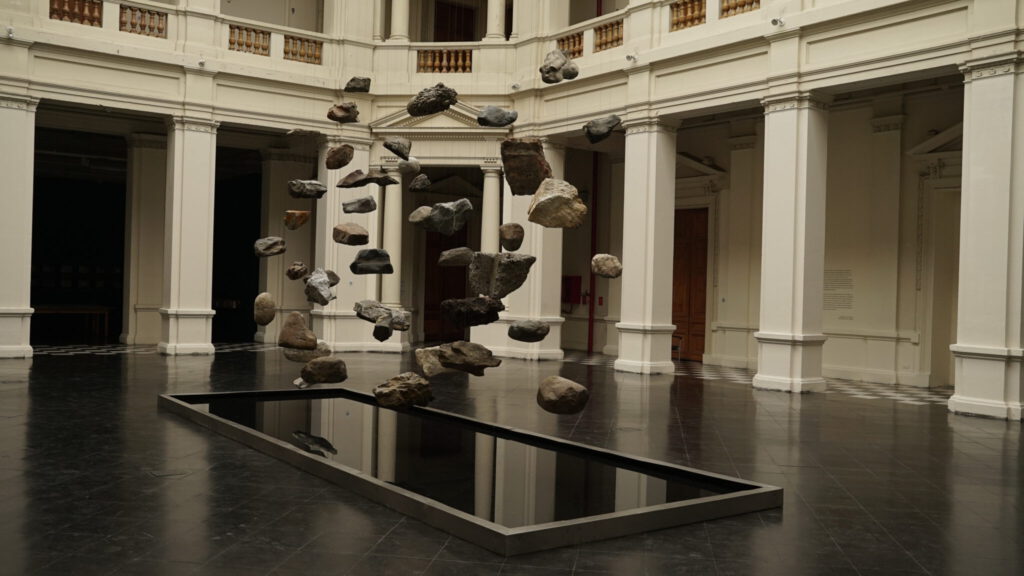
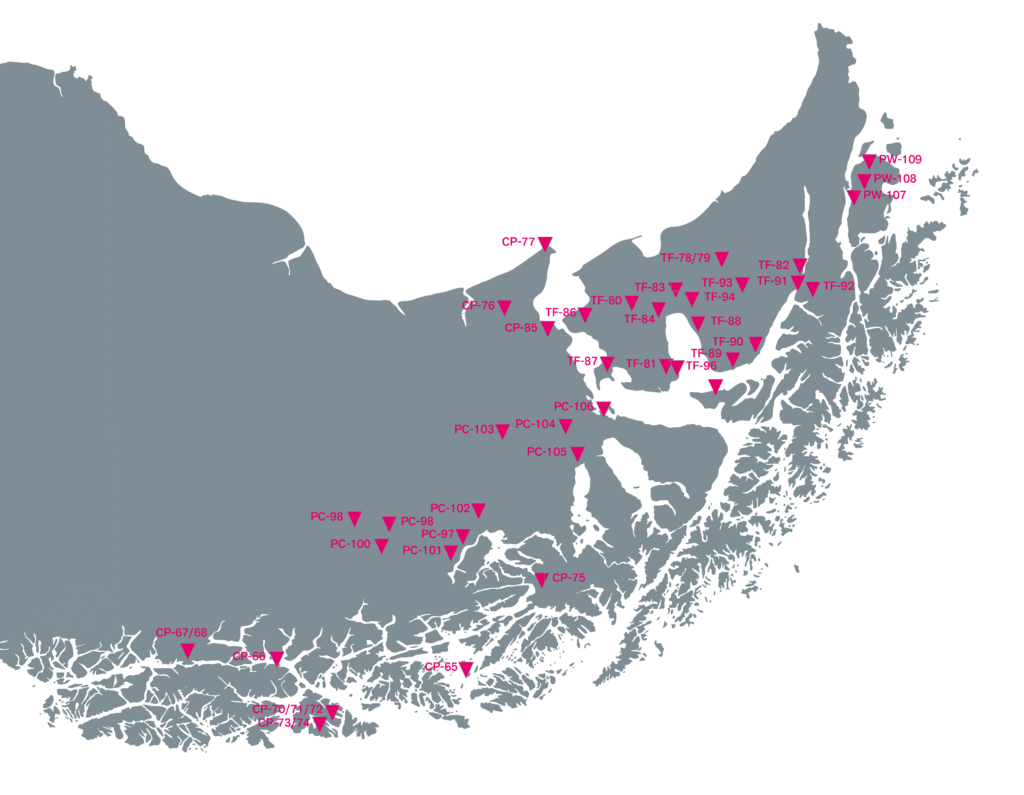
A sound installation by Nicolás Spencer made up of 44 stones in suspension – all collected from Fiordo Témpano north of Puerto Edén to Cabo de Hornos and about to be returned to the place where they were found. In addition to being considered part of the living heritage of the southern territory, the rocks are conceived as lithic witnesses of geological, historical or present-day events.
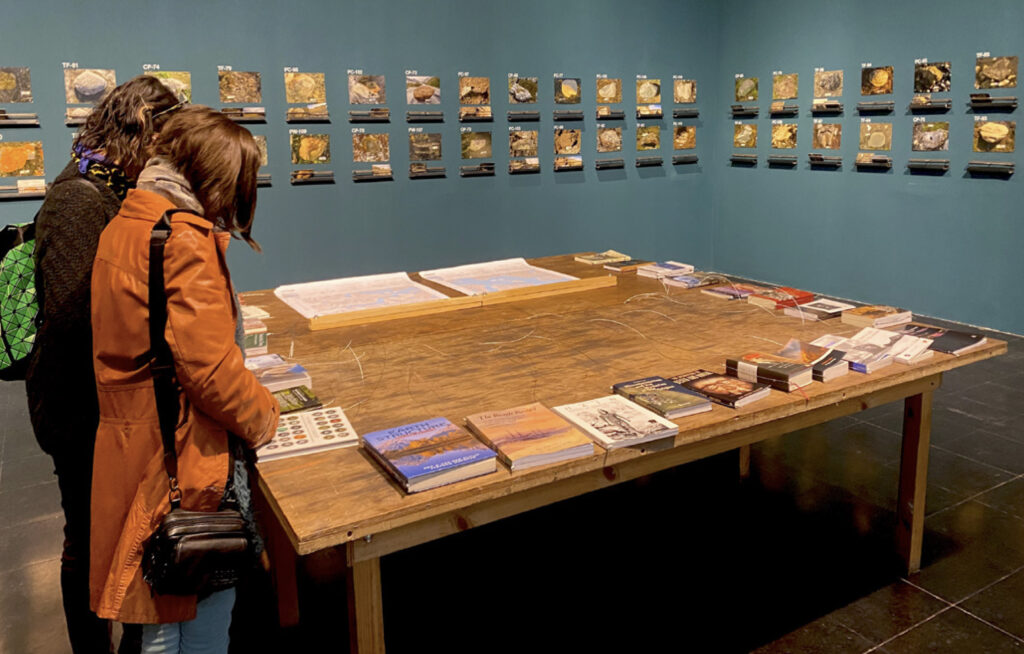
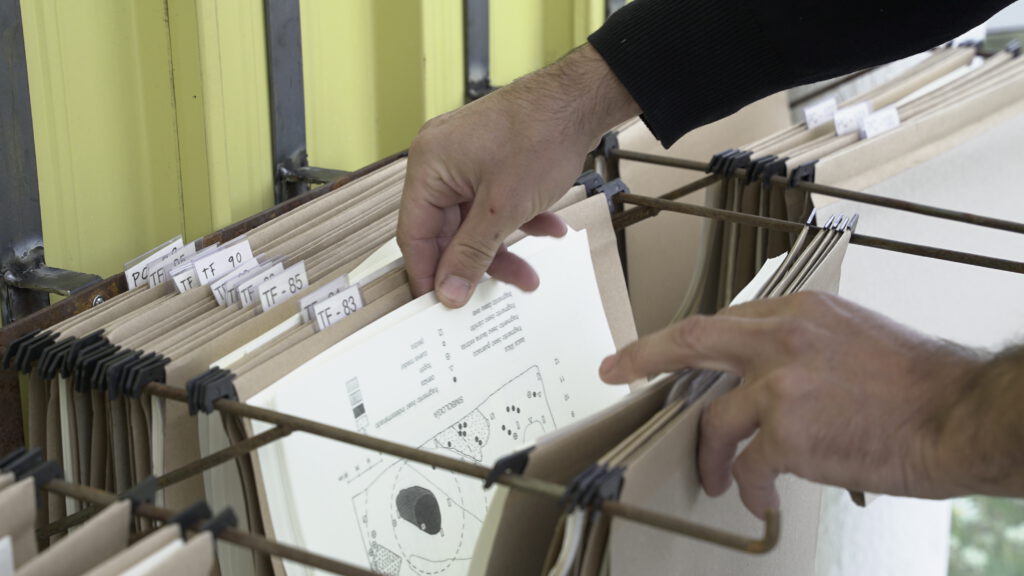
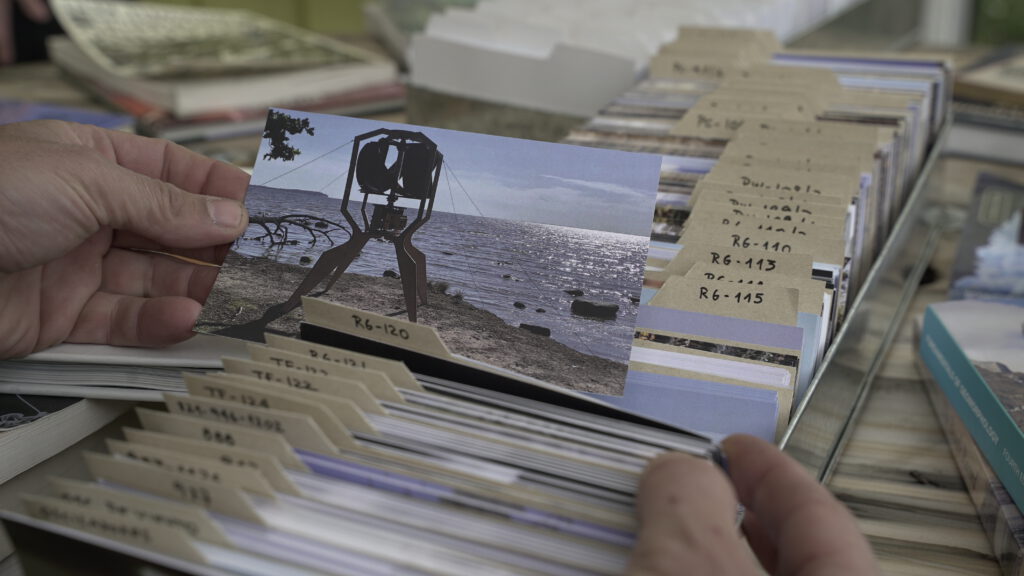
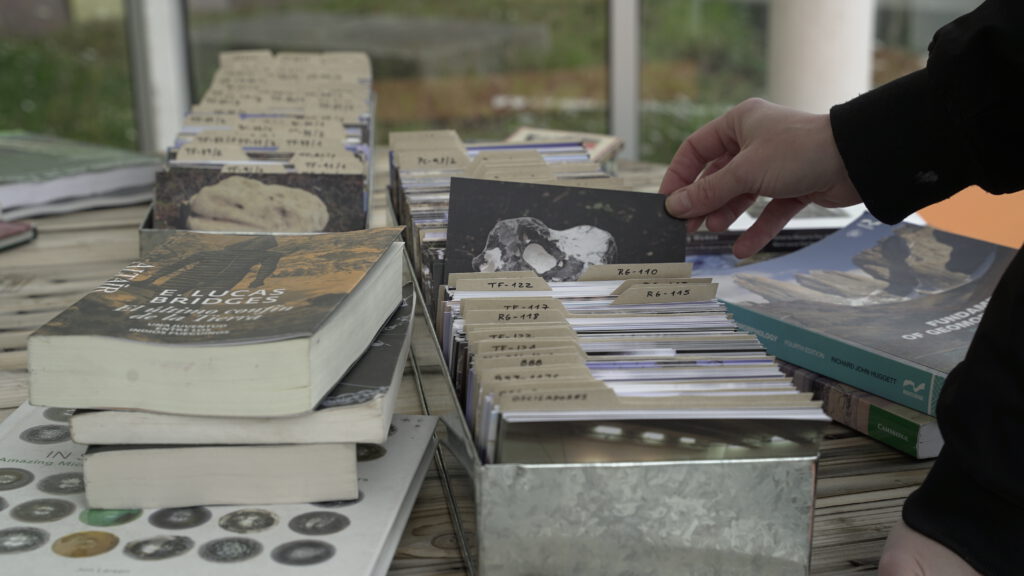
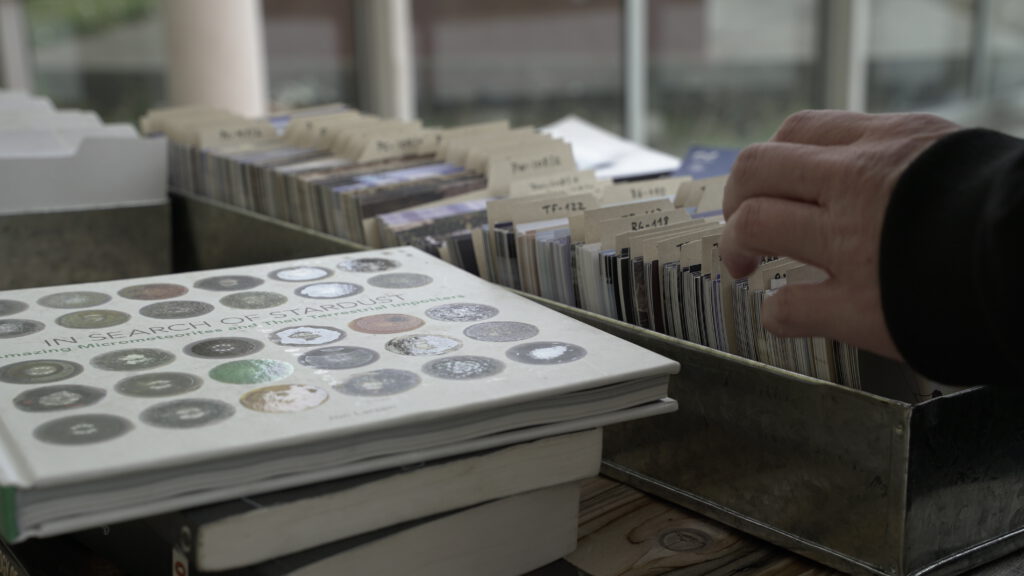
The installation is complemented by a mediation table of the extensive archival work carried out, which includes more than 2000 pages of scientific papers, articles, images and stories and can be accessed on a digital platform. Two postcards corresponding to each stone can also be consulted: the first, of a scientific nature, shows its formal and material characteristics and its geographical location; the second, of a poetic nature, shows a story assigned to a collaborator who approaches the object from his or her own discipline.
CP-65 Aguilera F. Oscar. (2016). Habitar en el espacio y el lenguaje: Un léxico de la geografía kawesqar. Magallanía, 44, 85-101. Risopatrón, Luis (1924). Diccionario Jeográfico de Chile. Colección: Biblioteca Nacional de Chile. Joseph Emperaire (1963). Los nómades del mar.
CP-66 Emperaire, J. (2002). Los nómades del mar. LOM. Laming-Emperaire, A. (1972). Los sitios arqueológicos de los archipiélagos de Patagonia. Anales del Instituto de la Patagonia, pag 3, 87-96
CP-67 Palacios, E. (2020). Guía de procedimiento arqueológico. Keynes, R. D. (Ed.). (2012). The Beagle Record: Selections from the original pictorial records and written accounts of the voyage of HMS Beagle. Cambridge University Press.
CP-68 Emperaire, Joseph (1963). Los nómades del mar.
CP-70 Hays, J. D., Imbrie, J., & Shackleton, N. J. (1976). Variations in the Earth’s Orbit: Pacemaker of the Ice Ages: For 500,000 years, major climatic changes have followed variations in obliquity and precession. Science, 194(4270), 1121-1132. Mathew, B. Glasser, N. (2009). Glacial Geology. Ice sheets and landforms.
CP-71 Peucker-Ehrenbrink, B., Schmitz, B. (Ed.) (2001). Accretion of Extraterrestrial Matter Throughout Earth’s History. Springer Science+Business Media, New York. Varela, F., Maturana H., Uribe, R. (1974). Autopoiesis: The organization of living systems, its characterization and a model. BioSystems, 5, 187-196. Álvarez F., Martini S., Hervé F., Guzmán C. (2009). Archipiélago Madre de Dios: Un patrimonio natural y cultural de la Patagonia Chilena. XII Congreso Geológico Chileno. MacKenzie, W.S. Guilford, C. (1980). Atlas of rock-forming minerals in thin section. Huggett, R. (2007). Fundamentals of Geomorphology. Tarbuck E. Lutgens F. (2005). Ciencias de la Tierra. Una introducción a la geología física. Lyell, Ch. (1830). Principios de Geología. Britannica Illustrated Science Library (2008). Rocks and Minerals.
CP-72 Letelier, J. P., Valenzuela M. (2020). First approaches to the exploration and study of micrometeorites in Chile: Understanding the flow of extraterrestrial material through the geological record. [Poster]. Sociedad Chilena de Astronomía, Chile. Maurette, M. (2011). Micrometeorites and the mysteries of our origins. Springer. Larsen, J. (2017). In search of stardust: Amazing micrometeorites and their terrestrial imposters. Voyageur Press, an imprint of Quarto Publishing Group. MacKenzie, W.S. Guilford, C. (1980). Atlas of rock-forming minerals in thin section. Huggett, R. (2007). Fundamentals of Geomorphology. Tarbuck, E. Lutgens F. (2005). Ciencias de la Tierra. Una introducción a la geología física. Lyell, Ch. (1830). Principios de geología. Britannica Illustrated Science Library (2008). Rocks and Minerals. Peucker-Ehrenbrink, B. Schmitz, B. (2001). Accretion of extraterrestrial matter throughout earth’s history.
CP-73 Ahmed, S. (2015). La política cultural de las emociones. Programa Universitario de Estudios de Genero Universidad Nacional Autónoma de México, Ciudad de México. Corte longitudinal de Isla Madre de Dios. Cusicanqui, S. (2015). Sociología de la imagen. Miradas ch’ixi desde la historia andina. Emperaire, J. (1963). Los nómades del mar.
CP-74 Palacios, E. (2020). Guía de procedimiento arqueológico. Moor, D. (1983). Flora of Tierra del Fuego. Revista Chilena de Historia Natural (56): 123-136. Corte longitudinal de Isla Madre de Dios. Emperaire, J. (1963). Los nómades del mar.
CP-75 Prieto, A., Chevallay, D., & Ovando, D. (2000). Los pasos de indios en Patagonia Austral. Desde el país de los gigantes I, 87-94. Univiversidad Nacional de la Patagonia Austral, Río Gallegos, Argentin
PC-76 Barberena, R., Blasi, A., & Castiñeira, C. (2006). Geoarqueología en Pali Aike: Cueva Orjas de Burro 1 (Patagonia, Argentina). Magallanía (Punta Arenas). Belardi, J. B., Espinosa, S., Carballo Marina, F., Barrientos, G., Goñi, R., Súnico, A., Bourlot, T., Pallo, C., Tessone, A., García Guraieb, S., Re, A., & Campan, P. (2010). Las cuencas de los lagos Tar y San Martín (Santa Cruz, Argentina) y la dinámica del poblamiento humano del sur de Patagonia: Integración de los primeros resultados. Magallanía (Punta Arenas). Bird, J. (1982). Enterratorios paleo-indios con cremación en las cuevas de Palli Aike y Cerro Sota en Chile meridional. Anales del Instituto de la Patagonia. MacKenzie, W.S. Guilford, C. (1980). Atlas of rock-forming minerals in thin section. Huggett, R. (2007). Fundamentals of Geomorphology. Tarbuck, E. Lutgens F. (2005). Ciencias de la Tierra. Una introducción a la geología física. Lyell, Ch. (1830). Principios de geología. Britannica Illustrated Science Library (2008). Rocks and Minerals.
PC-77 Mapa de ubicación y geomorfológico de Punta Dungeness. Uribe, P., & Zamora, E. (1981). Origen y geomorfología de la Punta Dungeness, Patagonia. In Anales del Instituto de la Patagonia. Huggett, R. (2007). Fundamentals of Geomorphology. Tarbuck, E. Lutgens F. (2005). Ciencias de la Tierra. Una introducción a la geología física. Lyell, Ch. (1830). Principios de geología.
TF-78 Borrazzo, K., Etchichury, M. (2013). Estudio de las materias primas líticas utilizadas para la manufactura de bolas en el norte de Tierra del Fuego (Argentina). Arqueología, 19. Borrazzo, K., Borrero, L. A., & Pallo, M. C. (2019). Exploring lithic transport in Tierra del Fuego (Southern South America). Journal of Archaeological Science: Reports, 24. Outes, F. F. (1906). Instrumentos modernos de los Onas (Tierra del Fuego). J.A. Alsina. Prieto, Alfredo & Cárdenas, P. & Bahamonde, Gabriel & Massone, M. (2004). Hallazgo de una fuente de materia prima en el chorrillo Miraflores, Tierra del Fuego, Chile. Magallanía, 32. Borrazzo, K. Morello, F. Borrero, L. D’Orazio, M. Etchichury, M. Massone, M. De Angelis, H. (2015). Caracterización de las materias primas líticas de Chorrillo Miraflores y su distribución arqueológica en el extremo meridional de Fuego-Patagonia. Chapman A. (1980). Barter as a Universal mode of Exchange. Borrazzo, K. D‘Orazio, M. Etchichury, M.(2010). Distribución espacial y uso prehistórico de las materias primas líticas del Chorrillo Miraflores en el norte de la Isla Grande de Tierra del Fuego (Argentina). Chatwin, B. (1987). Los trazos de la canción.
TF-79 Madrid González, C. F. (2019). Petrogénesis de la formación Palomares y del Complejo Volcánico Packsaddle [Thesis, Universidad Andrés Bello]. MacKenzie, W.S. Guilford, C. (1980). Atlas of rock-forming minerals in thin section. Britannica Illustrated Science Library (2008). Rocks and Minerals.
TF-80 Foto original de la expedición de Popper 1886 del Valle de los Estrechos. Chapman, A. (2002). Fin de un mundo: Los Selk’Nam en Tierra del Fuego. Taller Experimental Cuerpos Pintados. Conferencia de Julio Popper en el Instituto Geográfico Argentino en 1887. Alonso Marchante, J. L. (2019). Selk’nam: Genocidio y resistencia (Primera edición). Catalonia.
TF-81 Warren, John K. (2006). Evaporites: Sediments, resources and hydrocarbons. Springer Berlin Heidelberg, New York. Schoph, J.William (2006). Fossil evidence of Archaean life. Philosophical Transactions of the Royal Society. 361 (869-885) DOI:10.1098/rstb.2006.1834 Corporación Laguna de los Cisnes. Geosmo y Monumento Natural. (8 de marzo 2015) Stromatolitos en Laguna Amarga Torres del Paine. 23 marzo 2022: https://www.cldc.cl/general-5
TF-82 Betka, P., Klepeis, K., & Mosher, S. (2016). Fault kinematics of the Magallanes-Fagnano fault system, southern Chile; an example óf diffuse strain and sinistral transtension along a continental transform margin. Journal of Structural Geology, 85, 130-153. Roy, S., Vassallo, R., Martinod, J., Ghiglione, M. C., Sue, C., & Allemand, P. (2020). Co‐seismic deformation and post‐glacial slip rate along the Magallanes‐Fagnano fault, Tierra Del Fuego, Argentina. Terra Nova, 32(1), 1-10. Lodolo, E., Menichetti, M., Bartole, R., Ben-Avraham, Z., Tassone, A., & Lippai, H. (2003). Magallanes- Fagnano continental transform fault (Tierra del Fuego, southernmost South America): MAGALLANES- FAGNANO FAULT IN TIERRA DEL FUEGO. Tectonics, 22(6), 1-26. Huggett, R. (2007). Fundamentals of Geomorphology. Tarbuck, E. Lutgens F. (2005). Ciencias de la Tierra. Una introducción a la geología física. Lyell, Ch. (1830). Principios de geología.
TF-83 Massone, M. (2001). Los cazadores después del hielo. La cueva de tres arroyos en el contexto del poblamiento humano inicial de fuego-patagonia [Tesis de maestría no publicada], Universidad de Chile.
TF-84 Prieto, A., Morano, S., Cárdenas, P., Sierpe, V., Calas, E., Christensen, M. & Gibbons, J. (2020). A novel child burial from Tierra del Fuego: a preliminary report. The Journal of Island and Coastal Archaeology, 15(3), 436-454. Pearson, M. (2000). The archaeology of Death and burial.
TF-85 Harambour, A. (2016). Un viaje a las colonias. Memorias y diario de un ovejero escocés en Malvinas, Patagonia y Tierra del Fuego (1878-1898). Harambour, A. (2017). Las estancias magallánicas: un modelo de arquitectura industrial y ocupación territorial en la zona austral.
TF-86 McCulloch, R., Bentley, M., Purves, R., Hulton, N., Sugden, D., & Clapperton, C. (2000). Climatic inferences from glacial and Palaeoecological evidence at the last glacial termination, southern South America. Journal of Quaternary Science – J QUATERNARY SCI, 15, 409-417. Rabassa, J., Coronato, A. M., & Salemme, M. (2005). Chronology of the Late Cenozoic Patagonian glaciations and their correlation with biostratigraphic units of the Pampean region (Argentina). Journal of South American Earth Sciences, 20(1-2), 81-103. Rabassa, J., & Coronato, A. (2009). Glaciations in Patagonia and Tierra del Fuego during the Ensenadan Stage/Age (Early Pleistocene–earliest Middle Pleistocene). Quaternary International, 210(1-2), 18-36. Rabassa, J., Coronato, A., & Martínez, O. (2011). Late Cenozoic glaciations in Patagonia and Tierra del Fuego: An updated review. Biological Journal of the Linnean Society, 103(2), 316-335. Huggett, R. (2007). Fundamentals of Geomorphology. Tarbuck, E. Lutgens F. (2005). Ciencias de la Tierra. Una introducción a la geología física. Lyell, C. (1830). Principios de geología
TF-87 Hazen, R., Grew, E., Origlieri, M., & Downs, R. (2017). Outlooks in earth and planetary material on the mineralogy of the “Anthropocene Epoch”. American Mineralogist, 102, 595 – 611. Huggett, R. (2007). Fundamentals of Geomorphology. Tarbuck, E. Lutgens F. (2005). Ciencias de la Tierra. Una introducción a la geología física. Lyell, Ch. (1830). Principios de geología
TF-88 Britannica Illustrated Science Library (2008). Rocks and Minerals. p.24 Huggett, R. (2007). Fundamentals of Geomorphology. Tarbuck, E. Lutgens F. (2005). Ciencias de la Tierra. Una introducción a la geología física. Lyell, Ch. (1830). Principios de geología. Mathew, B. Glasser, N. (2009). Glacial Geology. Ice sheets and Landforms.
TF-89 Torres, J. (2009). La pesca entre los cazadores recolectores terrestres de la Isla Grande de Tierra del Fuego, desde la prehistoria a tiempos etnográficos. Magallanía, 37(2), 109-138. Morano, S., Sierpe, V., Prieto, A. (2009). Rescate del Chenque de Cerro Guido. Arqueología de la Patagonia. Arqueología de la Patagonia: una mirada desde el último confín (tomo 2), 661-668
TF-90 Chapman A. (2002). Fin de un mundo. Los selk’nam de Tierra del Fuego. Taller Experimental Cuerpos Pintados. Courtois, J. Martinic M. Pizzi M. Kirschbaum, Valenzuela María (1999). Las estancias magallánicas: un modelo de arquitectura industrial y ocupación territorial en la zona austral. Transcripción testimonio de Miguel Lawner Steiman: http://testimonios.museodelamemoria. cl/?s=Lawner%20Steiman%20Miguel
TF-91 Bridges, T. (1933). Yamana-English: A dictionary of the speech of Tierra del Fuego. Ediciones Shanamaim. García, S. (2015). Los orígenes de las comunicaciones terrestres en el sur de Tierra del Fuego (Chile). Magallanía, 43, 5-43 Ingold, T. (2007). Materials against materiality. Archaeological Dialogues, 14, 1-16 Pistrick, E., Isnart, C. (2013). Landscapes, soundscapes, mindscapes: introduction. Etnográfica, 17, 503-513 Smithson, R. (1992). A sedimentation of the mind: Earth projects. 82-91.
TF-92 García, C. Prieto, A. Spencer, N. (2021). El paso Kent: Transhumancia entre el Canal Beagle y Seno Almirantazgo (Documento inédito) Tierra del Fuego, Chile Mocho, F. (1898). En el Mar Austral: Croquis fueguinos. 262. Kent, R. (1924). Voyaging: Southward from the Strait of Magellan. Wesleyan University Press Imagen Bahía Blanca, Puerto Parry,
TF-93 Del real, I. (1928). Cuaderno de notas. Serrano, R. (1879). Tierra del Fuego derrotero de la excursión a la isla grande de la Tierra del Fuego durante los meses de Enero i Febrero de 1879. Harman, G. (2018). Ontología orientada a objetos: una nueva teoría del todo. Harman, G. (2016). El objeto cuádruple, una metafísica de las cosas después de Heidegger. Lyell, Ch. (1830). Principios de geología.
TF-94 Díaz-Andreu, M. Sørensen, M.L.S (1998). Excavating women. Towards an engendered history of archaeology. En Díaz-Andreu, M. and Sørensen, M.L.S. (eds.) (2012). Excavating Women. A History of Women in European Archaeology. London, Routledge. Díaz-Andreu, M. and Sørensen, M.L.S. (eds.) (2012). Excavating Women. A History of Women in European Archaeology. London, Routledge.
TF-95 Harambour, A. (2018). Los prohombres y los extintos. Patrimonio, identidad e historiografía regional en Magallanes. Cuadernos de historia (48) 57-88. Alonso Marchante, J. L. (2014). Menéndez, rey de la Patagonia. Catalonia. Alonso Marchante, J. L. (2019). Selk’nam: Genocidio y resistencia (Primera edición). Catalonia. Chapman, A. (1986). Los Selk’nam: la vida de los Onas en Tierra del Fuego
TF-96 Vejámenes inferidos a indígenas de tierra del fuego Tomo III. Punta Arenas, Chile: Corporación Nacional Indígena XII Región. (2002). 198 p. Disponible en Colección chilena, Biblioteca Nacional. Alonso Marchante, J. L. (2014). Menéndez, rey de la Patagonia. Catalonia. Alonso Marchante, J. L. (2019). Selk’nam: Genocidio y resistencia (Primera edición). Catalonia. Chapman, A. (1986). Los Selk’nam: la vida de los Onas en Tierra del Fuego
PC-97 Chatwin, B. (1987). Los trazos de la canción. Titivillus Chatwin, B. (2014). En la Patagoni
PC-98 Pearson, M. P. (2008). The archaeology of death and burial. Texas A & M University Press. Zilio, L. (2013). Chenques en Patagonia Centro-meridional: análisis de los patrones de distribución espacio-temporales. Comechingonia, 17, 237-254
PC-99 MacKenzie, W.S. Guilford, C. (1980). Atlas of rock-forming minerals in thin section. Lyell, Ch. (1830). Principios de geología. Britannica Illustrated Science Library (2008). Rocks and Minerals
PC-100 Legoupil, D. (2009). La ocupación del alero de Cerro Castillo: Un sitio residencial en un mirador panorámico. Magallania (Punta Arenas), 37(1), 47-60. Fajardo, C. De la contemplación estética a la interacción participativa (2009). Enunciación No14, núm.2, Colombia.
PC-101 Imagen pintura rupestre Cerro Benitez. Spencer, C. (2015). L’ordre dans la fragmentation psychique de la schizophrénie. Topique, 132, 65-78 Bate, L. (1970). Primeras investigaciones sobre el arte rupestre de la Patagonia chilena (1) Segundo Informe. Anales del Instituto de la Patagonia, 2, 33-41. Legoupil, D., Prieto, A., Sellier,P. (2004). La cueva de los niños (Seno Última Esperanza): Nuevos hallazgos.Magallania, 32, 225 – 227. Vygotsky, Lev (1931). Historia del desarrollo de las funciones psíquicas superiores
PC-102 Catrileo, M. (2018). Pelom y la vía láctea en la cosmovisión mapuche. Revista de Lenguas y Literatura Indoamericanas–antes Lengua y Literatura Mapuche–, 20, 1-16. Echeverría, A. (2017). La representación del ritual funerario mapuche en Reducciones de Jaime Huenún. Latin American Research Review, 52(5), 838-853. Palacios, C., & Sierpe, V. (2019). Análisis bioarqueológico de un feto anencefálico del sitio arqueológico Cueva de los Niños (Provincia de Última Esperanza, Región de Magallanes, Chile): A 29 años de su hallazgo. Magallanía (Punta Arenas), 47(2), 107-124. Sellier, P. (1999). Los restos óseos de los dos niños de la sepultura de Última Esperanza (Magallanes, Chile): un feto anencefálico y uno nacido muerto. En Anales del Instituto de la Patagonia.
PC-103 Cita de Fugitivo en la patagonia Cita de Patagonia meridionalle e Terra del Fuoco: memorie di un missionario nel cinquantenario delle missioni salesiane Imagen Cacique Mulato Fotografía Cacique Mulato y su Familia. En Librería de Marangunic y Cia. Punta Arenas. Colotipo, fotomecánico policromo sobre papel. Fotografía Caciques Mulato y Canario. Chile, 1892 y 1900. Editor no identificado. Colotipo, fotomecánico monocromo sobre papel. Fotografía Charles Furlong W. (Chile, 1907). Cacique Mulato con dos compañeros. Aike Biblioteca Digital de la Patagonia, Universidad de Magallanes. La Prensa Austral (7 de mayo 2016). Casimiro Bigua Cacique de dos mundos padre de Cacique Mulato. Sosa, N. (2014). Tehuelches en la feria de Saint Louis (Louisiana, 1904). Revista Tefros, 4(2), 8. Martinic Beros, M., Prieto Iglesias, A., & Cárdenas, P. (1995). Hallazgo del asentamiento del jefe aónikenk. Mulato en el valle del Zurdo, una prueba de la sedentarización indígena en el periodo histórico final. Vieira, M. (2014). Magallanes y la lucha contra las enfermedades infecciosas de los niños. Muerte, pasión y vida (Parte II). Revista chilena de infectología. Correa, A. La toma de rehenes y el cautiverio interétnico en el espacio fronterizo pampeano (primeras décadas del siglo XIX). Proyecto, 04-04594
PC-104 Sepúlveda, M (2011). Pinturas rupestres y tecnología del color en el extremo sur de Chile. Magallanía, (2011). Vol. 39(1) pp. 193-210. Prieto, A. Morelo, F. Cárdenas, R. Christensen, M. (1998). Cañadón Leona: A sesenta años de su descubrimiento.
PC-105 Emperaire, J. (Prólogo de Laming-Emperaire, A) (2002). Los nómades del mar, LOM. Junius Bird y Joseph Emperaire en el desarrollo de la arqueología prehistórica de Magallanes durante la primera mitad del siglo XX. Emperaire, J. (1963). Los nómades del mar.
PC-106 Martinic Beros, M. (1988). Un Robinson suizo en el Estrecho de Magallanes. Revista Patagónica, 35, 19-22. Martinic B, M. (2013). LOS AÓNIKENK ¿EPITOME DEL BUEN SALVAJE? Magallania (Punta Arenas), 41(1), 5-27. Butto, A. Saletta, M. Fiore D. (2015). Kau. Los toldos tehuelches en los dibujos, grabados y fotografías de viajeros por la Patagonia (Argentina y Chile).
PW-107 Bridges, T. (1987). Yamana-English. A dictionary of the speech of Tierra del Fuego. Bridges, Lucas (2010). El último confín de la tierra.
PW-108 Transcripción del relato sin editar de Julia González Calderón, “Historia Roca Gigante”. Bridges, Lucas (2010). El último confín de la tierra.
PW-109 Rivera C., S. (2015). Sociología de la imagen. Miradas ch’ixi desde la historia andina. Tinta Limón, Buenos Aires.